Showing posts with label Transportation. Show all posts
Thursday, October 29, 2020
#atxcouncil: Attacking Trump (while asking for money)
"An evildoer gives heed to false lips;
A liar listens eagerly to a spiteful tongue."
Proverbs 17:4
“Mobility for All” is the establishment aligned political action committee promoting Project Connect. They recently sent out the above mailer. Not surprisingly, it attempts to cast citizens concerned about the initiative’s 25% tax hike as captives of a cabal of non-binary, non-gendered, boogiepersons in the minds of liberal Austinites.
But for as much as the views of “weapons dealers” may or may not swing the election, one choice of target is: Trump Inauguration Attendees.
Because, whether they want to admit it or not, Project Connect’s supporters are the ones asking Donald Trump for money.
As the trade publication “Mass Transit mag” explained this summer: “CapMetro will now pursue 45 percent federal funding of this $7.1 billion, with a local match for the remaining funding coming through a voter-approved tax rate election for Project Connect.”
Whether or not they want to admit it, right now that means asking Donald Trump for the money. Obviously, Biden could [Note: Probably will] win. But Austin voters have to make their decision on Project Connect BEFORE they know the answer to that question.
On the other hand, asking 45 (Trump) for 45 (percent of the funding for Project Connect) is an amusingly ironic set of numbers.
Bottom Line: Seriously, y'all are the ones asking him for money, not us.
Thursday, February 6, 2020
Texas Monthly's DERP SQUAD Apparently Unaware that Taxes Impact Cost of Living
"But the former governors who were before me laid burdens on the people, and took from them bread and wine, besides forty shekels of silver. Yes, even their servants bore rule over the people, but I did not do so, because of the fear of God."
Nehemiah 5:15
It's not a secret that this author grew up in New York City. Or that cost of living issues played a significant role in why we moved to Texas. Thus this Texas Monthly piece a few weeks back caught our interest:
This is, obviously, a self-evidently moronic statement to anyone who's spent more than fifteen minutes in either city.
Nevertheless, we were curious about what statistical sleight-of-hand they'd used to come up with such a preposterous conclusion.
Our friends at Economics21.org looked deeper:
The CBC report includes property taxes in the cost of housing for homeowners and expresses housing and transit costs as a percentage of before-tax rather than after-tax median income. Therefore, the CBC’s methodology will overstate the burden of housing costs in areas where property taxes are an unusually large portion of overall tax revenue. As it turns out, Texas is exactly such a place.Derp.
Property taxes in Texas are high. In Harris County, which includes most of the Houston metropolitan area, the effective tax rate is 2.31%—in the top five percent of all counties in the United States and about three times the average effective rate of 0.8% in New York City proper. (New York’s convoluted system of property assessment gives many wealthy homeowners even bigger breaks on property taxes: Mayor Bill de Blasio, for example, owns two $2 million townhouses on which he pays property taxes of 0.2%.)
Texans, however, enjoy much lower taxes than New Yorkers in other domains. The state has no income tax, for example, whereas state income taxes in New York range from 4% to 8.82%. According to the Tax Foundation, in 2010, property taxes accounted for 45.2% of total state and local tax receipts in Texas but just 32.4% in New York state (most of which has higher property tax rates than the city). New Yorkers also pay for most of the costs of their public transit through tax subsidies, which come out of residents’ taxes but isn’t counted as a transportation expense in the CBC report.
Also this:
Even after these questionable methodological choices, the CBC still finds that living in Houston costs less in absolute dollars. But as a percentage of income, New York, which has a higher average household income, is cheaper. This is true, but the lesson that Texas Monthly draws by implication—that workers moving from New York to Houston would see their incomes drop by more than enough to offset the lower cost of living—rests on a false inference that ignores the differences between the two regions’ economies.Double Derp.
The New York metropolitan area has a high average income because it is unusually filled with skilled professionals who could earn high incomes anywhere; meanwhile, the region’s high housing prices have driven lower-income workers to leave. The Houston region, on the other hand, has a proportionally larger working-class population. This difference is reflected partially in educational attainment figures: 38.7 percent of NYC residents aged 25 and above had a BA or higher, compared to just 31.8 in Houston. Therefore, if a worker earning an average salary in New York left for Houston, he would quite likely earn well above Houston’s average income.
The perils of the CBC’s income adjustments are exemplified by the fact that the San Jose area, where small bungalows sell for a million dollars or more, had the third lowest housing expenses relative to income. This is largely because San Jose is filled with extremely high-earning technology workers: the average household income in the region is above $124,000. But if you’re not a computer programmer, you would be foolish to think that you could save money on housing costs by moving to San Jose.
[Note: The Econ 21 piece has links to their data that are worth exploring. Unfortunately, we can't directly copy them due to formatting issues. We strongly recommend reading the whole thing, and clicking through some of the links, here.]
In other words, Texas Monthly's claim was accurate...except for every single detail.
Bottom Line: Houston certainly has some things New York City lacks. Cheating-ass baseball teams first and foremost. A higher cost of living, however, is not one of those things.
Monday, November 25, 2019
For an 18-year incumbent with "Seniority," Cornyn can't even work system
"And whatever you do in word or deed, do all in the name of the Lord Jesus, giving thanks to God the Father through Him."
Colossians 3:17
We recently observed traffic on I-35 in downtown Austin when we had a thought: Isn't I-35, technically, a federal highway?!?
Furthermore...isn't our senior Senator the #2 Republican in the United States Senate?!?
Obviously, this website doesn't *really* support pork-barrel governance. Taxpayers elsewhere in the U.S. shouldn't *really* subsidize I-35 expansion. Still, for such a situation to emerge under the jurisdiction of a U.S. Senator who claims to "work within the system" indicates said U.S. Senator's incompetence.
Put differently: $23 Trillion national debt...and John Cornyn STILL can't secure funding for (already federal) I-35.
It's quite something.
Lyndon Johnson and Sam Rayburn may have been completely wretched. But at least Texas got some infrastructure out of them. With John Cornyn, we get the wretchedness without the infrastructure.
Bottom Line: If we're going to be stuck with a U.S. Senator who doesn't represent our values, they ought to at least manipulate the status quo to Texas' advantage. Cornyn can't even do that. What purpose does he serve?!?
Tuesday, October 29, 2019
#atxcouncil: Homelessness and the FASCINATING Political Geography of Abbott's Jurisdiction
"[R]edeeming the time, because the days are evil."
Ephesians 5:16
We've obviously said our piece about Greg Abbott and Austin homelessness. We think Abbott's talked a lot more than he's acted. Furthermore, the modest actions coming this week don't really solve anything.
Last night, however, we we discussing all of the above with a friend who lives in North Austin. We explained why we think there's less to Abbott's announcements than meets the eye. This person didn't disagree, but then said something we hadn't considered:
You're probably right...but if all Abbott does is use TxDOT to clean out the area under highway overpasses, it'll take care of everywhere [the homeless] congregate in my neighborhood.Not a bad point.
[Note: Emphasis added.]
The primary place the State of Texas (and thus Abbott) has jurisdiction is highways.
Given that, consider how highways intersect Austin city council districts. Specifically in North Austin:
Districts 6 and 10 have elected Republicans in recent memory. District 7 has never been seriously contested. In the current climate, however, it really ought to be (*).
- MoPac is entirely within district 10 and the most conservative parts of district 7.
- US-183 snakes through districts 7, 10, and 6.
- Even I-35 gets in on the act in district 7.
None of this, of course, is to say that TxDOT moving homeless individuals away from highway overpasses really solves the problem.
But it is to say that it could make a visible difference in the lives of the type of people who are swing voters in local elections.
Maybe even enough to change turnout models...especially for December runoffs.
Bottom Line: Given where everything's located, even underwhelming changes could have an oversize impact.
-------
* - By Republicans AND sane Democrats.
Friday, December 7, 2018
#atxcouncil: Frank Ward's Great Austin Holiday Adventure
"In all your ways acknowledge Him,
And He shall direct your paths."
Proverbs 3:6
From Frank Ward's Campaign:
Highlights:
- Greg Casar - "I just don't think that we are in the business of reducing congestion."
- Ann Kitchen - "That's not really our goal, to get rid of congestion."
- Note: It's not in the video, but in the original audio Jimmy Flannigan agrees with Kitchen.
- Ward - "Reducing congestion is not really their goal, you have got to be kidding me."
- Ward - "We have to do something about this traffic."
Bottom Line: Vote for Frank Ward if you value dissent and intellectual diversity. Early voting runs through tonight (Friday) at 7pm. Election Day Tuesday.
Wednesday, May 2, 2018
#atxcouncil's latest act of DIMWITTED TYRANNY illustrates why #TXLEGE MUST GO FURTHER THAN Huffines' Transportation Bill
"Neither do they put new wine into old vessels: for then the vessels would break, and the wine would be spilt, and the vessels would perish: but they put new wine into new vessels, and so are both preserved."
Matthew 9:17
Here we go again:
The Austin City Council early Friday morning gave its regulators a hammer to brandish on electric rental scooters and dockless bikes. What remains to be seen is when the city will use it.Predictably followed by:
The council, on a unanimous vote, approved an ordinance tweaking several sections of existing city law to make it clear that leaving scooters or bikes on city right of way for rental is illegal in Austin, absent that person or company applying for and receiving a city license to do so. The new ordinance also clarifies that the city may impound such vehicles found in violation of city rules, redeemable by the owners at the cost of $200 for each scooter or bike.
Robert Spillar, director of the Austin Transportation Department, said after the meeting that his office, after sending warning letters to the two companies now operating scooters on the streets — Bird Rides and LimeBike — would begin impounding scooters for the companies operating without a license.
The ordinance says that no person — including customers, not merely representatives of the scooter or bike companies — may “place, store, or park, or allow another person to place, store, or park, a vehicle, machinery, or other item on a street, alley or sidewalk” for the purpose of selling, renting or leasing the item.
AUSTIN -- Two motorized scooter companies have pulled their fleets from the streets of Austin after the city council adopted an emergency ordinance.Annnnnd sigh....we've seen this movie before.
Both LimeBike and Bird came under fire after bringing their business to Austin without permits from the City. In fact, a Thursday night council meeting lasted until 3 a.m. Friday in part due to debate over the controversial scooter companies, which allow users to register the scooters for use via smart phone and then leave them in sidewalks or streets for the next user once they are done.
Dan Keshet details the potential stakes:
new technology has the potential to change cities in extraordinary ways: dockless scooters as well as their kin, dockless and docked bikes, hoverboards, e-bikes (personal or shared), etc. The post will focus exclusively on dockless scooters, but many of the observations and almost all of the recommendations apply to their cousins.Keshet goes on to discuss various economic and technical reasons why he sees so much potential in various dockless technologies. You really should read the whole thing. The short version is that it's a potentially very low cost was for significant numbers of people to get where they're going without adding to traffic.
Why do I see so much potential in these little devices? In part, it’s because dockless bikes have already claimed a huge share of transportation users in places they’ve been deployed at scale, despite only having been around a couple years and despite having some challenges scooters don’t have.
There's a lot we could say about this topic, but we'll leave it at this: We told the Texas Senate so (sorta, but even we didn't fully understand where technology was headed).
Last year, as the Texas Legislature was cleaning up the Austin (and other cities) City Council's Uber debacle, the Texas Senate heard several bills related to municipal ground transportation regulations. Most of the bills were limited to TNC-style "ridesharing" services (eg. Uber/Lyft). But Senator Don Huffines had SB 113, which would have forbidden municipal regulation of passenger transportation services provided through traditional automobiles.
We testified in favor of Senator Huffines' bill specifically because it was the only one we thought could anticipate the next municipal ground transportation debacle. But even that bill was only limited in scope to services provided though traditional automobiles. At the time (which was barely over a year ago) dockless scooters et. al. weren't even something we'd imagined.
And that's a textbook example of why we need a permissionless standard when it comes to new technology.
Bottom Line: The cheapest and easiest solution for traffic congestion is to allow new technologies to meet consumer demand. Unfortunately, the municipal governments want "their" cut. Thus the legislature really should step in and put an end to these shakedowns once and for all.
Wednesday, April 25, 2018
Abbott engages in "pro-taxpayer" publicity stunt (while TxDOT loses ANOTHER $5 Billion)
"A fool’s lips come with strife, and his mouth calleth for stripes."
Proverbs 18:6
LOL:
Gov. Greg Abbott is demanding that former U.S. Rep. Blake Farenthold "cover all costs" of the special election to fill his seat using the $84,000 the Corpus Christi Republican used to settle a sexual harassment claim years ago.At first glance, it seems like a decent enough gesture. Farenthold is certainly a jerk [Note: Though it's probably worth pointing out that, while WE called for Farenthold to go at the time, Abbott never did]. Furthermore, Farenthold is also departing in the most obnoxious way possible.
Farenthold, who abruptly resigned earlier this month, had promised to pay back the $84,000 — which came out of a taxpayer-funded account — after that settlement was made public last year but hasn't so far.
In a letter to Farenthold on Wednesday, Abbott said the former congressman should return the money to taxpayers by funding the June 30 special election to finish his term.
"While you have publicly offered to reimburse the $84,000 in taxpayer funds you wrongly used to settle a sexual harassment claim, there is no legal recourse requiring you to give that money back to Congress," Abbott wrote. "I am urging you to give those funds back to the counties in your district to cover the costs of the June 30, 2018, special election."
But come on...$84k?!?
That's not even a rounding error in government; that's not even a fraction of a rounding error.
Meanwhile, you'll never guess what landed in our inbox an hour ago:
Texans Uniting for Reform and Freedom (TURF), Texans for Toll-free Highways PAC, and Grassroots America - We the People PAC contend the much-lamented funding shortfall is largely due to the Texas Department of Transportation’s (TxDOT) bloat and mismanagement of funds. While metropolitan areas scramble to re-allocate funds to advance projects without tolls, as Governor Greg Abbott and Lt. Governor Dan Patrick directed last November, the anti-toll groups argue TxDOT intentionally squandered the nearly $5 billion a year in new funding on low priority projects so they could force toll roads on urban commuters.Bottom Line: Why fix transportation funding (aka. doing the job to which you were actually elected), when you can grandstand over the minuscule cost of a special election?!?
The grassroots groups say this is a systemic problem identified in the 2016 Sunset Commission Staff Report which states, “As currently structured, TxDOT’s project development process is not meeting expectations and is not prepared to effectively handle the influx of new transportation funding projected to double over the next decade. TxDOT has not met key on-time or on-budget measures for several years, indicating underlying problems with the department’s management of its project portfolio through complex steps including environmental review, design, and right-of-way acquisition.”
....
Hall and Fleming point out that the passage of House Bill 20 in 2015 should have addressed TxDOT’s perpetual failure to allocate funding to the state’s 100 Most Congested Roads by forcing the agency to implement project scoring and performance measurements that ensure objective data, not politics, guide the agency’s project selection process.
“The Transportation Commission’s current process for determining how much money to allocate to different statewide transportation goals tends to favor horse trading among various interests more than consideration of performance information…Existing project prioritization process validates status quo instead of advancing projects based on need or impact. TxDOT’s current approach to prioritizing projects does not actually serve as a tool to evaluate which projects are strategically best, but rather works backwards to validate projects that are already in development,” noted the Sunset Staff Report.
[Note: Emphasis in original.]
Tuesday, October 24, 2017
#TXLEGE: Meanwhile, Straus' Interim Charges are a spend/regulate-athon....
"He who is often rebuked, and hardens his neck,
Will suddenly be destroyed, and that without remedy."
Proverbs 29:1
Joe Straus also released interim charges yesterday:
- Study the Texas olive and olive oil industry. Provide suggestions to improve, promote, and standardize the industry. Examine current policy related to the industry and examine factors such as research, marketing, labeling, standards, data collection, and the necessity of creating a commodity board or similar type of organization.
- Note: We wonder which lobbyist is getting paid on this one; also, which major industry player will benefit from this act of protectionism.
- Study the effects of declining migratory species, such as the monarch butterfly, as well as native and domesticated bee populations on agricultural production and its economic impact on the state. Identify possible causes of the population changes and monitor national trends. Make recommendations on how to improve and promote monarch butterfly and bee populations and habitats in the state.
- Note: Because, clearly, Texas' state government is capable of "improv[ing] and promot[ing] monarch butterfly and bee populations.
- Examine the use of federal funds by state agencies responding to the effects of Hurricane Harvey and identify opportunities to maximize the use of federal funds to reduce the impact of future natural disasters. Also, identify the need for state resources to respond to Harvey relief and recovery efforts, as well as opportunities for state investment in infrastructure projects that will reduce the impact of future natural disasters.
- Note: Spend, spend, spend....all while hitting up the Feds for even more.
- Straus' also gives the Appropriations Committee roughly a dozen charges to review the operations of state agencies. In theory, this could be either a useful exercise or a smokescreen for another spend-a-thon. We'll let you guess which one we think will happen.
- Evaluate whether counties have the necessary ordinance-making and enforcement authority to deal with flood risk in unincorporated rural and suburban areas of Texas. Additionally, examine whether counties have adequate resources and authority to ensure that new development in unincorporated areas is not susceptible to flooding.
- Note: Regulate, regulate, regulate.
- Study the feasibility of establishing and mobilizing a volunteer contingency of private boat owners through the boat registration and license database administered by the Texas Parks and Wildlife Department to assist first responders in search and rescue efforts in natural disasters like Hurricane Harvey.
- Note: If this already happened during Hurricane Harvey without the state government being involved, why does the state government need to get involved at this point?!?
- Evaluate the ongoing and long-term workforce needs of the state’s businesses and industries. Determine whether state resources are adequate to address shortages and assist with closing existing or future gaps in workforce readiness and skills to ensure the continued economic security and success of the state.
- Note: Spend, spend, spend.
- Review Texas’ open meeting laws and related government decision-making policies. Determine if the formal processes prevented the efficient delivery of assistance during Hurricane Harvey. Make recommendations on maintaining the current standards of accountability without limiting government-provided aid during disaster events.
- Note: That's a loophole you could drive a truck through.
- Determine, to the extent possible, the scope of financial losses to 2- and 4-year institutions, including facilities, that resulted from Hurricane Harvey. Recommend possible state actions to mitigate any negative impact on institutions and ensure governance structures and parameters allow for effective responses. Review the educational opportunities offered to students displaced by Harvey throughout the state. Recommend any changes that could improve the process and what additional services might be needed for these displaced students.
- Note: Spend, spend, spend.
- Study aggressive driving in Texas and review the causes and current mitigation efforts. Make recommendations for legislative action.
- Note: Regulate, regulate, regulate.
- Study the use of appraisal processes under property insurance policies in Texas, including the effects of court decisions on the use of these processes and the impact of their use on insurers and policyholders.
- Note: Regulate, regulate, regulate.
- Review local and state zoning and land use regulations. Determine if current rules provide an adequate balance of disaster preparedness and deference to private property rights.
- Note: Regulate, regulate, regulate.
- Examine Texas’ eminent domain statutes to ensure a balance between necessary infrastructure growth and fair compensation for landowners. Review available public information and data relating to the compensation provided to private property owners. Make recommendations to improve the accountability, as well as successful development, of the entities granted eminent domain authority.
- Note: Nice property rights you've got there, be a shame if anything happened to them.
- In fairness to Straus, he gives the Licencing and Administrative procedures committee a couple of charges that might be helpful.
- Note: Stopped clock, twice a day, and whatnot....
- Examine the potential value, the necessary elements, and the implications of a broad-based information and awareness campaign regarding water issues in Texas. Consider input from water stakeholders, educators, and communications experts.
- Note: Spend, spend, spend.
- Evaluate the governance structures, including investment oversight, of the Employee Retirement System (ERS), Teacher Retirement System (TRS), Texas Municipal Retirement System, Texas County and District Retirement System, and Texas Emergency Services Retirement System. Identify best practices and make recommendations to strengthen oversight within the systems.
- Note: In theory this could either be useful or a spend-a-thon; we'll let you guess which will happen.
- Determine, to the extent possible, the scope of financial losses, including facilities, that resulted from Hurricane Harvey. Recommend possible state actions, such as changes to student counts or property valuation, to mitigate any negative impact on districts and ensure governance structures and parameters allow for effective responses.
- Note: Spend, spend, spend.
- Review current state mechanisms for identifying and rewarding educators through state-level strategies. Examine how providing additional funding to enhance compensation in districts facing a shortage of experienced, highly rated teachers would affect retention and teacher quality, in addition to whether it would encourage teachers to provide additional services through extracurricular activities, tutoring, and mentoring.
- Note: Didn't the Governor propose doing this during the special session?!?
- Examine programs in public schools that have proven results meeting the needs of and improving student achievement for students with disabilities, with an emphasis on programs specializing in autism, dysgraphia, and dyslexia. Recommend ways to support and scale innovative programs for these students, including providing supplemental services, or incentivizing public-private partnerships or inter district and charter school collaborations. Monitor the implementation and funding for the pilot programs authorized in H.B. 21 (85R) and review the Texas Education Agency's compliance with S.B. 160 (85R), which prohibits special education student caps.
- Note: Spend, spend, spend.
- Review the charter school system in Texas. Determine if changes are needed in the granting, renewal, or revocation of charter schools, including the timeline for expansions and notification of expansions to surrounding districts. Review the educational outcomes of students in charter schools compared to those in traditional schools, and to what extent schools participate in the alternative accountability system. Monitor the implementation of facilities funding for charter schools. Consider differences in state funding for charter schools compared to their surrounding districts and the impact on the state budget. Consider admissions policies for charters, including 33 appropriate data collection to assess demand for additional charter enrollment, compliance with access by students with disabilities and the effect of exclusions of students with criminal or disciplinary histories. Consider differences in charter and district contributions to the Teacher Retirement System on behalf of their employees and make appropriate recommendations to support the retirement benefits of all public school teachers.
- Note: Straus imitates Bill DeBlasio.
- Study treatment of traumatic brain injury, Alzheimer's, and dementia, and recommend opportunities for advancing treatment and cures.
- Note: Spend, spend, spend.
- Study and make recommendations to improve services available for identifying and treating children with mental illness, including the application of trauma- and grief-informed practices. Identify strategies to assist in understanding the impact and recognizing the signs of trauma in children and providing school-based or community-based mental health services to children who need them. Analyze the role of the Texas Education Agency and of the regional Education Service Centers regarding mental health. In addition, review programs that treat early psychosis among youth and young adults.
- Note: Parental rights be damned.
- Study the efficacy of existing transportation finance mechanisms from state, regional, and local perspectives. Identify opportunities to improve existing transportation finance mechanisms and investigate the feasibility of developing new ones.
- Note: Spend, spend, spend.
- Monitor and evaluate the need for affordable housing in urban and rural areas across the State of Texas. Examine whether existing housing programs are adequately addressing the needs for affordable housing. Identify prospective and innovative ideas and solutions to address affordable housing needs in Texas.
- Note: Subsidize, subsidize, subsidize.
- Examine local government oversight of abandoned and substandard buildings, including buildings of historical significance. Identify ways to best address these issues in an efficient and effective manner.
- Note: Regulate, regulate, regulate.
Read the full list of Interim Charges here.
Thursday, June 29, 2017
"Capitol Complex" project epitomizes EVERYTHING wrong with both #ATXCouncil and #TXLEGE....
"Then the Lord God took the man and put him in the garden of Eden to tend and keep it."
Genesis 2:15
Wow; we had no idea this was even under discussion until we saw today's Statesman story:
After a closed-door discussion Thursday, Austin City Council members agreed to waive $6.9 million in fees and provide other assistance to the state for a new Capitol Complex — a topic that had drawn wry skepticism during a council workshop earlier in the week.There's so much to say about why this is a terrible idea, but we'll start with a personal observation we made numerous times throughout this past regular legislative session. If you walk around the area north of the Capitol Grounds and south of UT campus after 6pm, you quickly notice that it's a dead zone once all the state employees go home at night. Having a dead zone between two of the most robust neighborhoods in the city (Downtown and Campus) is one of the worst missed opportunities we have for land use in this city.
The Capitol Complex is a planned $581 million three-phase project to convert North Congress Avenue between the Capitol and the University of Texas into a grassy pedestrian mall. The later phases will create new office buildings for state workers at 16th and 18th streets. Work is expected to begin this summer.
The 6-2 vote Thursday, with two abstentions and one council member absent, authorizes city staffers to draft an interlocal agreement with the state to waive fees for the first phase of the Capitol Complex project. It would also provide expedited permitting for the project, appointment of a city staff project team and an agreement that the city will vacate four blocks of North Congress Avenue and convert 16th, 17th and 18th streets to two-way traffic.
As we made that observation over the past few months, we've come to an increasingly obvious conclusion: the State of Texas should sell that land (or, at a minimum, do a long-term ground lease) for mixed-use residential/commercial development.
Beyond that, there's the city of Austin's chronic housing shortage. If this area were properly re-developed, you could get 10,000 additional units of housing supply in a desirable location, which can only lower housing costs citywide. And the best part is that you wouldn't have to displace any current residents, because there aren't any current residents.
Then there's the traffic consideration. The primary driver [Note: Pun not originally intended, but left in place after being recognized] of traffic on I-35 is state employees commuting to and from work. Getting all those state employees off of I-35 and replacing them with people who aren't travelling long distances to their job can only ease traffic congestion.
Then there's the cost: $581 million to build luxury office towers for state employees. One thing we learned during the Courthouse bond campaign two years ago is that construction costs in less prime locations are a fraction of construction costs on prime real estate. If this project moves forward, it's safe to predict it'll cost twice as much as advertised, take twice as long to complete as predicted, then once the project belatedly opens the buildings will rapidly depreciate to the point where within 7 years they'll need another infusion of cash for "maintenance."
Finally, of course, there's the ongoing nightmare of the city of Austin's fee and permitting process. We've long been of the belief that the city needs to streamline fees and permitting for everyone and end the constant stream of "fee waivers" and "expedited permitting." That the state of Texas was able to obtain special treatment is yet another example of how politically favored entities receive accommodations which are unavailable to the rest of us.
Bottom Line: Never forget, once you get beyond the headlines, that politics at every level in this state is about good ol' boys putting together shady real estate deals....
Friday, April 7, 2017
#TXLEGE Tampon Lobby prioritizes (literal) legislative pork over transportation funding....
"But evil men and impostors will grow worse and worse, deceiving and being deceived."
2 Timothy 3:13
[Note: For a complete account of last night's budget shenanigans, see Empower Texans here, LoneStarVoice here, and the Trib here.]
The Texas House passed it's draft "budget" last night. To be honest, it was everything you would expect from a chamber controlled by Joe Straus. Nevertheless, one move from Tampon lobby water carrier Drew Springer stands out even by their standards:
The biggest drama of the night came after Representative Jonathan Stickland (R-Bedford) filed an amendment to nix funds for a $900,000 agriculture program intended to mass exterminate wild hogs in order to stop the "hogapocalypse," as it's been called. Stickland called the "feral hog abatement" program a total waste of taxpayer dollars — which had rural lawmaker Drew Springer (R-Muenster) rattled. To retaliate against Stickland, Springer tacked on an amendment to Stickland's hog proposal that would eliminate $900,0000 of the Texas Department of Transportation's road maintenance funds specifically for Bedford, Stickland's hometown. Springer's vindictive amendment actually passed, officially making Stickland the most despised dude on the floor and forcing Stickland to withdraw his feral hog amendment. The two lawmakers nearly got into a physical fight on the House floor.Read the whole thing here.
Learn more about Drew Springer's stupid tampon bill (including its completely predictable co-author) here.
Bottom Line: Yes, 99 members of the Texas House of Representatives actually attempted to punish a colleague by eliminating funding to relieve traffic congestion in a major urban area.
Thursday, October 20, 2016
Independent Businesses along "Corridors" wise up to Adler's Bond
"Dishonest scales are an abomination to the Lord,
But a just weight is His delight."
Proverbs 11:1
Take this story, multiply it at least 1000 times over (esp. on Burnet rd. and South Lamar), and you begin to gain a picture of the devastation this bond will cause if it passes:
More Austin business owners are getting upset as they learn what effect passage of Proposition One will have on their livelihoods. Ashley Schor is the owner of "Bead-It", a jewelry supply store that's been on South Lamar near Oltorf. She says the corridor plans for Lamar would likely cut her income in half during construction. "It's going to change the landscape of this whole entire strip of businesses. So it will make Austin look like wall-to-wall condos."Read the whole thing here.
Schor has lived in Austin all her life and has been in business here for fifteen years. She says the corridor plans aligned with Proposition One mean her store and old oak trees on the land could be endangered, to make way for the city's preferred streetscapes. "And it will also destroy all these old houses that are just floating, barely hanging on by a thread. It will just knock us all out, one by one by one by one."
Schor says she is considering repainting the outside of her store to protest Proposition One.
Wednesday, October 5, 2016
"Corridor" bond proponents LYING all over town....
"Lying lips are an abomination to the Lord,
But those who deal truthfully are His delight."
Proverbs 12:22
[Author's Note: We tried to include a picture to the map to which the Statesman piece refers, but couldn't make the formatting work; you can view it for yourself by following the link.]
[Author's Note II: All points of emphasis in the linked pieces added.]
OK, that's enough.
Following the debacle of the Uber/Lyft referendum, we took a vow of humility. We think we've done a pretty good job holding that up, but a vow of humility is not a suicide pact. And continued reprehensible behavior from those we characterized back in May as "the other group of arrogant jerks" warrants a response.
That's our long-winded introduction to a conclusion that we can no longer avoid (even if it's not surprising): Over the past week, Mayor Adler and the team supporting his so-called "corridor" bond have graduated from half-truths and political spin to bald faced lies.
Example 1: Ben Wear in Monday's Statesman....
The glossy four-page brochure in question arrived in tens of thousands of Austin mailboxes, including mine, about a week ago courtesy of Austin Forward, the political action committee formed to support the city’s $720 million transportation bond program. I’m guessing you’ve heard of the bond and might be thinking of voting yes or no by Nov. 8.It gets better:
Anyway, given that I have been steeped in all things proposition for many months now, I didn’t bother to actually read the brochure when it arrived. I figured there was nothing in there that would surprise me. It turns out there was: the map.
The map dominates the mailing’s third page (and is on the campaign’s website), below this headline: “The Smart Corridor Plan: Helping ALL of Austin.” That’s their capitalization, not mine.
And the map certainly seems to back that up, with a green lines splayed over 34 roads, all over the map. There’s no legend identifying what the green lines signify, although there is a key with 15 roads listed, tied to numbers on the map.
Manchaca Road is green all the way from South Lamar Boulevard to FM 1626. South Congress is green from Cesar Chavez Street to, again, FM 1626. East Martin Luther King Jr. Boulevard is shown as having work from Interstate 35 well out into unincorporated Travis County. South Pleasant Valley Road is green from Cesar Chavez to Oltorf Street. Guadalupe Street is green from East Martin Luther King Jr. Boulevard to where it meets North Lamar Boulevard. And North Lamar, too, appears to be set for work from somewhere near West 35th Street all the way north to its terminus at Howard Lane.
South Austin, in particular, is a focus, with huge sections of the road network shown in, yes, green.
I was startled, because I hadn’t heard of any construction in the bond proposition for many of those roads. What in the world?
Here’s the deal: As I explained last week in this space, the $482 million included in the bond for work on eight or nine corridors won’t come close to paying for the actual construction on all of them. The city staff estimates a cost of $1.56 billion to do just seven of them, and William Cannon and Slaughter would inflate that number by some other undetermined, but sizable, amount.Example 2: Greg Harrison with Empower Texans....
So the green lines — which, again, a reasonable reader could see as showing actual street improvements on all of those places — in fact show an indistinct combination of work that would occur, work that might occur and work that definitely won’t occur under the bond because in those cases it only supplies money for studies. And there’s no way for the uninitiated to know which is which, short of going to the online city brochure. And even then you won’t know which of the seven or eight or nine smart corridors will actually get done.
The bond proposition, if voters say yes, would fund $720 million of work (more than the sum total of approved Austin transportation bonds over the past 20 years), and almost all of that would involve actual moving of dirt and laying of concrete or asphalt (some large part of that would be for sidewalks, bike lanes and trails, not street lanes). The mayor and other supporters argue, based on engineering studies already done on six of the corridors, that the changes would ease traffic on those roads and provide sufficient and safe alternatives for people who use their feet, bikes or a bus.
[Note: There are a lot of numbers in this analysis, but the TL:DR version is that the tax increase is going to be three times what the city claims.]
Repeatedly, the City of Austin and multiple publications have stated that the projected tax impact for Mayor Adler’s $720 million transportation bond would be around $56 per year for an average homeowner, but one local taxpayer says the true cost will be more than double that figure.Read the whole thing here and here.
Herein lies the confusion: tax impact does not reflect the overall amount the average homeowner will have to shell out to pay for it. In fact, it is an intentional misrepresentation that uses figures based on the assumptions that not only will officials be diligent in executing a shell-game down the road, but that their math within this misleading paradigm is correct.
But according to John Goldstone, a local attorney who regularly investigates bond proposals, the City’s math just doesn’t add up.
“The number [$56] is inaccurate for various reasons,” says Goldstone. “The least of which that the number represents only 2/3 of the bonds ($480 million as per the city’s own documentation) and is misleadingly called a ‘tax impact.’ Officials are relying on the fact that some of the other municipal bonds will be paid off by the time the final $240 million is issued, so your net impact of that final $240 million is $0.00, a blatant lie by confusion.”
In other words, by issuing the debt in phases, they can obfuscate the overall amount taxpayers will have to shell out to cover the entire package. “In layman’s terms,” Goldstone says, “it is as though we have paid off an $800 car payment right when we borrow for an $800 mortgage – so our net ‘impact’ is zero.”
“They’re advertising it as though the repayment cost of a $240 million loan is zero,” he says.
But even given that assumption the City’s calculations are still flawed, according to Goldstone.
“With a principal amount of $720 million, repayment terms of 5% (on the conservative side of the city’s own published terms), amortized over 20 years with 2 payments per year comes out to the city paying (at full funding) $57,364,175.76 per year,” Goldstone says.
“As per Greg Canally (Deputy Chief Financial Officer for the City of Austin), the total taxable property that pays property taxes in City of Austin is $115 billion…so to find out what a $100,000 slice of that would owe, we take 100,000 / 115 billion – which gives us our percentage, which we multiply by the yearly payment of the bond as calculated – coming out to $49.90 per $100,000, or $125 per $250,000,” Goldstone explains.
“The real number is $125 per year for a $250,000 house.”
Saturday, August 27, 2016
Gauldin strongly positioned in #ATXCouncil District 7
"When the righteous are in authority, the people rejoice;
But when a wicked man rules, the people groan."
Proverbs 29:2
[Author's Note: District 7 covers North Central Austin, from Burnet Rd. up to Parmer Lane.]
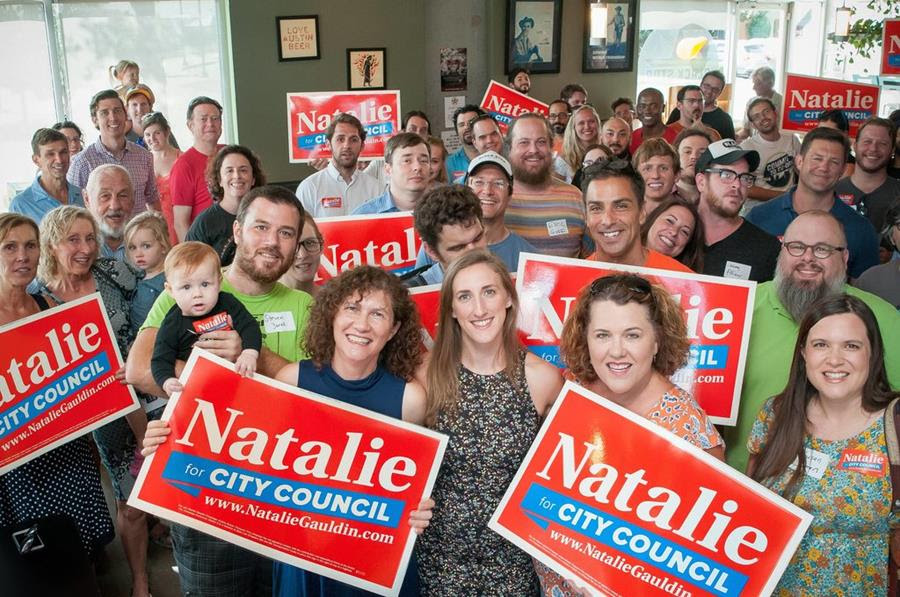
Looks like Natalie Gauldin has Leslie Pool one on one; from her latest campaign newsletter:
I’m excited to announce that I am officially the ONLY candidate challenging the incumbent District 7 City Councilmember. This is great news for our campaign! We will not need to head into a runoff and we will not need to compare ourselves to other candidates. Voters will have two choices and I am confident that our message will resonate with the majority of District 7 residents. Maintaining the status quo is not enough to truly address the transportation and affordability concerns of the average Austinite. It’s time for a change down at City Hall and we can get there with YOUR help!We can't find a link to the full newsletter, but you can sign up to receive e-mails for yourself here.
Thank you to everyone who has been spreading the word about this campaign. I have been going door to door speaking with voters daily since July. In that time, I’ve had countless people mention seeing the yard signs out in the area or having spoken with their supportive friends. I really appreciate you helping to give me a head start on earning their votes.
....
Whether you choose to participate in the campaign by block-walking in the area or by making a contribution to the campaign, we thank you for your support. By joining together in this effort, we are confident we can continue to move towards a more affordable Austin with transportation options that work for everyone. Make sure to stay tuned for exciting updates on social media and our website over the next few weeks.
Tuesday, August 23, 2016
Patrick, Kolkhorst, and the Texas Senate Transportation Committee chair....
"When the righteous are in authority, the people rejoice;
But when a wicked man rules, the people groan."
Proverbs 29:2
We received the following text message from NE Tarrant Tea Party yesterday:
We had no idea they were pushing for this, but sign us up!
Texans Uniting for Reform and Freedom (TURF) is the best transportation group in the state; according to their 2015 scorecard, Kolkhorst got an A+ on transportation issues last session while Nichols got an F.
We're not super familiar with Kolkhorst's record on all transportation issues, but we know she's really good on toll roads (and those are the biggest scam of the whole lot).
This could also only help any potential Uber/Lyft legislation that might emerge.
Yes, thank you!!!
Friday, August 19, 2016
Adler already stretching facts to sell bond....
“For My people are foolish,
They have not known Me.
They are silly children,
And they have no understanding.
They are wise to do evil,
But to do good they have no knowledge.”
Jeremiah 4:22
Soo, this happened:
We'll set aside the discussion of transit vs. roads for another day; we want to focus on the underlying veracity of Adler's claim.
Adler's bond has nothing related to rail. Rail was actually the subject of substantial political wrangling last week, but the rail advocates lost that round. No "increase in access to public transit" there.
Buses, of course, are controlled by CapMetro. Council and the Mayor have no jurisdiction there. No "increase in access to public transit" there.
We suspect that, if cornered, Adler would refer to the "dedicated transit lanes" in the corridor plans. But dedicated lanes don't increase access to anything. At best, assuming you take the city's claims at face value, they might make the public transportation system more efficient at some vaguely defined point down the road.
LOL, nice try.
Thursday, August 18, 2016
Adler's bond gets worse; votes melt away....
“For My people are foolish,
They have not known Me.
They are silly children,
And they have no understanding.
They are wise to do evil,
But to do good they have no knowledge.”
Jeremiah 4:22
It's a shame it had to work this way, but we suppose it isn't a surprise:
Read the whole thing here.Divided Austin City Council puts $720 million bond on November ballot
Austin voters, who already had some weighty decisions to make Nov. 8, will now have a $720 million question to answer as well.
An unexpectedly divided Austin City Council gave final approval Thursday to Mayor Steve Adler’s “go big” transportation bond proposition, a mixture of improvements to major city arterial streets; bikeway, sidewalk, trail and transit expansions citywide; and suburban highway projects. What had been an 11-0 preliminary vote a week ago fell to 7-1-3 Thursday, with some council members raising concerns about the ballot language, tax impact and even the rushed process that led to the huge bond proposition.
“I am dismayed that a $720 million bond that is on the November ballot is a product of the way things have always been done,” said Council Member Ora Houston, who represents District 1 in East Austin, explaining her “no” vote. “I feel like I’ve been bullied.”
Council Members Delia Garza, Ellen Troxclair and Don Zimmerman, for various reasons, abstained.
If Austin voters OK the all-or-nothing package, which is five times larger than any transportation bond ever approved in the city, the city property tax by about 2020 would increase by around $56 a year on a $250,000 home.
The council, in giving third-reading approval to an ordinance calling the bond election, also agreed on the specific and lengthy ballot language. Voters will see a single sentence, about 150 words long, that names nine major roads that would be reworked to include alternative transportation modes. The ballot will also name highways that would be expanded and city streets designated for repairs.
That language, however, will not include a specific estimate of what the property tax effect will be for an average home owner. The council last week, on a preliminary 6-5 vote, had said it wanted such wording.
But after an executive session Thursday morning, the council emerged and voted 7-4 against including that provision on the ballot, doing so on the advice of the city attorney. Zimmerman, Troxclair, Garza and Houston were in the minority on that vote.
Assistant City Attorney Leela Fireside in last week’s open session had told the council that if the tax impact of the bond borrowing over time approached what appears on the ballot, that could limit spending under the bond to some amount lower than $720 million. She recommended against including such language.
That advice continued in Thursday’s closed session, an incensed Zimmerman said. He left the backstage meeting early.
“It’s not legal advice, it’s lobbying,” Zimmerman said. “There’s a difference. I’m sick of it. They want to give the city the unlimited power to tax.”
The real shame here is that some components of this package have merit. But they've been shoved into an enormous, complicated amalgamation. And if you have any faith in the city of Austin's ability to execute this in anything remotely resembling a competent or timely manner, we have mineral rights in South Texas we'd love to sell you.
If Adler were serious about addressing mobility, he could have done two things over the summer:
- Break the bundled proposal into its component parts, giving voters several smaller/ simpler propositions from which to choose.
- Delivering a credible and detailed plan for how the city would execute this plan if the voters say yes.
Unfortunately, Adler did neither of these things.
[Sidenote: Before anyone asks, that was the exact message we delivered council (twice) back in June.]
And that's before we review the actual ballot language; if that's not legally binding, that's a whole separate can of worms.
Kudos to Zimmerman, Troxclair, Houston, and Garza for not walking this plank; it doesn't take a genius to see a coalition.
Bottom Line: Bond packages are usually unanimous. For Adler to lose four votes on the dais is pathetic. Then again, considering the aloof presumption with which Adler has conducted himself throughout this process, it isn't surprising.
Thursday, August 11, 2016
Can the #ATXCouncil Transportation Bond be salvaged?!?
“For My people are foolish,
They have not known Me.
They are silly children,
And they have no understanding.
They are wise to do evil,
But to do good they have no knowledge.”
Jeremiah 4:22
Let's start by stating the obvious: This bond package took several steps backwards over the summer.
This is disappointing, though it's not surprising.
We've been torn since this discussion began. We don't hate the underlying concept behind 'smart corridors.' Doing things like getting buses out of traffic when they're making stops and improving signal timing make a certain amount of sense (at a certain cost). In general, we like using technology to create new efficiencies.
The problem is that the city's transportation department can't implement this proposal in anything resembling a competent or timely manner. That's why we testified (twice) back in June that we wanted to see the city present a "credible plan for execution" when they came back in August. In other words, we wanted to see how they would get from point A to point B.
Six weeks later...they won't even commit to a firm location for point B. There literally isn't even a specific list of project to which they're committing. There's a phase for that: BLANK CHECK (and a $720 million one at that).
According to certain scuttlebutt, there's going to be an effort tonight to use amendments on the dais to reign in the proposal; consider us skeptical.
Bottom Line: We cannot support this bond in its current form; while we'd love to be pleasantly surprised, for Council to improve it sufficiently enough at tonight's meeting to merit support seems like a tall order.
Saturday, August 6, 2016
#ATXCouncil transportation bond looking worse and worse....
“For My people are foolish,
They have not known Me.
They are silly children,
And they have no understanding.
They are wise to do evil,
But to do good they have no knowledge.”
Jeremiah 4:22
LOL, when Mayor Adler loses the Chronicle:
This is the latest tentative project list from the mayor's office. But it's worth noting that, in the ballot language and bond proposition that Council is currently considering, very little of this is actually specified. The regional mobility projects and existing corridor plans are named, but the bond language states only that the money will be spent on projects, including those, attaches no specific dollar amount to any of them, and does not mention any of the specific future corridors and substandard roadways listed below. The Local Mobility money is broken down to the general categories listed below, but with none of the specific substandard roadways identified.Seriously, do read the whole thing here.
Friday, August 5, 2016
#ATXCouncil Budget/Bond (bad) news and notes....
“For My people are foolish,
They have not known Me.
They are silly children,
And they have no understanding.
They are wise to do evil,
But to do good they have no knowledge.”
Jeremiah 4:22
The fiscal tea leaves from city hall do not look good. We discussed the budget trainwreck last week. The indefatigable Austin Affordability digs down deeper:
Before you even start reading this, get ready to think about what you can do to help. The proposed City Budget is moving like a freight train through City Hall. We don’t have much time to slow it down. What we face is a taxpayer, utility ratepayer and fee payer disaster on two major levels:1. The budget raises property taxes by 8% above the effective rate, which is the highest allowed under Texas law, without triggering a rollback election.
2. Every utility charge and utility add-on fee is slated for increases – so high that the total dollar impact on the “typical” resident is 2.4 times higher than the record tax increase!
....
How Does the City Staff Rationalize These High Proposed Increases?
In Volume 1, Page 29 of the budget, you will find a cheerful note declaring that a “typical family” would only pay $324 per month for City taxes and fees. They state that this is only 4.8% of the median family income for our region. Well, just look at your utility bills and your property tax bills. Then, sit down with your neighbors and take a look at theirs. Ask each other how many of you would consider yourself “typical,” based on this chart in the Budget. If you live in anything larger than a small condo, your utility bills, fees and taxes are probably much higher.But here’s the biggest flaw in the argument about City taxes and fees being “only a tiny portion” of your annual income. That doesn’t account for the long parade of other taxes from AISD, Travis County, Central Health and ACC. Of course you could isolate just one taxing entity on your total bill and claim that it isn’t really all that bad. But hey, we have to pay the entire bill! And it’s absurd to suggest that a “typical” family currently pays only $221 per month on their utility bills. The mere suggestion put forth in the City Manager’s proposed Budget that we the citizens don’t have a problem with these costs is outrageous, preposterous and insulting to our collective intelligence!
Next, the potential transportation bond. Sources have told us it's gotten worse since it went to the city manager. We had planned to loop back to it next week, but the Statesman has some recent developments:....How Could the City Council Easily Trim the Budget?
Last year I fought hard to convince them to apply cost of living pay increases on a sliding scale. The wealthy managers and executives at the top do not need the same percentage increase as the lowest paid grunt workers. Several City Council members spoke favorably of the idea and even floated various scenarios to make it happen. I pointed out that many times during my 35 year career as a State employee, the Legislature gave us flat dollar amounts as pay raises. This helped the lowest paid workers and held down the skewed impact of percentage increases. But last year, the City Manager sent a screaming and crying letter to the City Council, complaining that the entire staff had been humiliated by the suggestion of more equitable pay increases. This caused the City Council to fold their tents and abandon the idea immediately.
Austin Mayor Steve Adler’s unprecedentedly huge transportation bond proposal appears to have survived its summer vacation.The Austin City Council, just back from a month off, had few discouraging words in an informal work session Tuesday as it discussed Adler’s $720 million proposal, which is largely focused on road improvements, and how it might go about putting the measure before voters in November. If the council wants to hold such an election, state law requires the council members vote to do so by Aug. 22.The council likely will take that definitive vote Aug. 18, after hearing from the public at an Aug. 11 council meeting.If approved, the bonds would trigger a property tax increase — phased in through about 2020 and in place for about 20 years after that — of just under $60 on a $250,000 home.
....[T]he council is focusing on the Adler plan, which is centered on overhauling up to eight key Austin arteries: North Lamar, Burnet Road, Airport Boulevard, East Martin Luther King Jr. Boulevard, Guadalupe Street, East Riverside Drive, South Lamar and another South Austin corridor to be chosen later. Under the proposal, the city would spend about $482 million adding bike lanes, medians, better sidewalks, trees, street furniture, bus pullouts and intersections improvements to those roads.The council voted 8-3 on June 23 to ask city staffers to bring back an election proposal in August, and that handiwork was before the panel Tuesday.
Rather than the arguments from the spring about how large the plan would be (it is five times larger than any transportation bond proposition previously approved by Austin voters) or its makeup, the council is now focused on how to make the request of voters. Between now and Aug. 18 the council must decide how specific and lengthy to make the language that will appear on the ballot.Read the original articles here and here.
There will be plenty of time for further comment, but we'll close (for now) with a suggestion: If Mayor Adler and the council majority are serious about passing a major transportation bond this fall, it would help their cause (and their credibility) to nip these Austin Energy "rate" and "fee" hikes (ie. tax increases) in the bud during the August budget season.
Friday, June 24, 2016
Notes on Yesterday's #ATXCouncil Meeting....
"There are many plans in a man’s heart,
Nevertheless the Lord’s counsel—that will stand."
Proverbs 19:21
[Author's Note: The full agenda for the meeting can be viewed here.]
We attended a substantial chuck of yesterday's uber-marathon Council meeting (14 hours and counting when we left at midnight; ultimately 16 hours). Our thoughts are in the order events occurred. For those only interested in the transportation bond, that discussion is at the end:
- Item 79: They actually approved approximately $275k per year to build 2 luxury public bathrooms on street corners downtown. This despite the fact that every downtown hotel already has bathrooms that any member of the public can use as long as they don't make a scene while doing so. Kathie Tovo justified this project on the grounds that the homeless would relieve themselves on the street if the city didn't provide facilities. Passed 8-2-1 with Zimmerman and Troxclair voting Nay and Gallo abstaining. We can't prove it at this point, but we strongly suspect someone's getting paid.
In addition, during later public testimony over the bond package, a female firefigher testified that there are numerous fire stations around Austin that don't even have male and female bathrooms despite the fact that a previous council moved seventeen years ago to provide them; for council to move forward with taxpayer funded luxury bathrooms at a time when city owned firestations have been waiting almost two decades for sufficient facilities seems...odd.
- Item 56: The ball appears to be slowly moving forward on APD's plan to buy license plate readers to scan citizens' vehicles. We're not a lawyer, and we haven't reviewed the relevant jurisprudence, but this strikes us as one of the most blatant violations of the fourth amendment we've ever seen. Making matters worse, the vendor will be allowed to keep data from license plate scans as long as it "has commercial value." So it's both unconstitutional and a special interest boondoggle. In addition, one of the members of the public who testified in opposition raised concerns over whether such a proposal would turn APD into "mobile debt collectors" for things like traffic tickets. Thankfully, they at least dropped the civil asset forfeiture component. Council voted 6-5 (Zimmerman, Troxclair, Casar, Houston, Garza, and Kitchen voting AYE) in favor of Zimmerman's amendment to restrict APD from "executing" the contract and merely allow them to negotiate it. This will be back in front of council in August.
- Items 57/58: Unfortunately, council went ahead with their poorly conceived APD body camera policy and contract. First things first, between the cameras and iphones being purchased to play the footage, we're talking about $17 MILLION. Council went forward with using Taser (yes, THAT Taser) for the cameras at a cost of $12 million despite the fact that another vendor (Utility) was offering a technically superior product at a fraction of the price (Author's Note: We apologize, but we didn't write down the number of their asking price).
Leslie Pool initially moved to postpone consideration of the contract to August, but she later pulled the motion after asking questions of APD. Kathie Tovo called now a "time for action" following a "deliberative" process. Keep in mind, they tried to ambush us with this contract 6 weeks ago.
More troubling is the incomplete policy council pushed forward related to body camera footage. While Kathy Mitchell of the Texas Criminal Justice coalition cited "incremental progress" in terms of allowing public greater access to body camera footage, there are still numerous hurdles to public access. A representative from the Electronic Frontier Foundation urged caution because whatever policy adopted by council would subsequently become subject to typical governmental inertia; specifically, "we should be very careful about a cobbled together system." Everybody supports police bodycameras, but there's no reason council couldn't have taken another month or two to get the policy right. Council will rue this day whenever the inevitable dispute between an officer and a citizen provokes outrage that this policy proves insufficient to quell.
Item 57 ($12 million for body cameras) passed 9-1-1 (Zimmerman voting Nay, Houston abstaining); Item 58 ($5 million for iphones) 7-3-1 (Zimmerman, Houston, and Pool voting Nay; Troxclair abstaining).
- "Special Called Meeting" -- Council also considered Ellen Troxclair's proposal to expand the city of Austin's homestead exemption to 14% from the current 6%. For obscure legal reasons, this had to be considered as part of a "special called meeting" instead the regular agenda. Council watered Troxclair's proposed 8% expansion (to 14%) all the way down to 2% (to 8%). We had actually left the meeting at this point so we missed the discussion, but it doesn't take a genius to figure out why the current council would water down a tax relief package.
[Author's Note: Community Impact has more here.]
- Item 83: This was the discussion of the Transportation bond. We left following public testimony, so we didn't see much of the discussion between council members. Something eventually passed 8-3, but we aren't familiar with the details and will refrain from commenting further until we digest said details.
That being said, we are going to re-iterate the concern we expressed in our public testimony and in our open letter to the mayor: Does the city bureaucracy have the capability to execute this plan in anything resembling a competent or timely manner?!? $720 million is a lot of money, and this package has a lot of moving parts. As the female firefighter testified, the city still hasn't been able to produce male and female bathrooms in fire-stations despite having promised to do so seventeen years ago. If they can't deliver bathrooms, are they really capable of successfully executing a major transportation project?!?
[Author's Note: The firefigher's testimony is at the 17:35 mark; our testimony is at 23:30]
Subscribe to:
Posts (Atom)