|
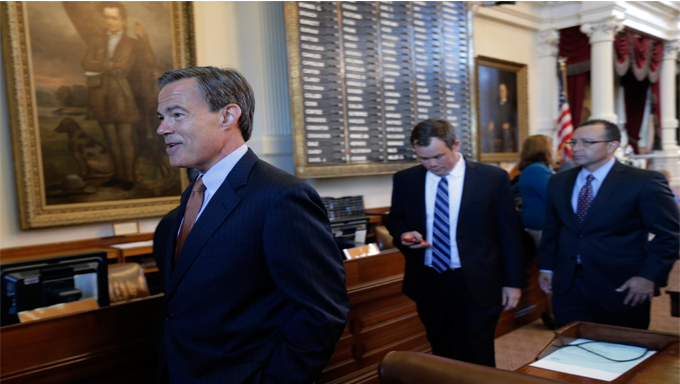
| Senator Van Taylor speaking at today's event |
"Poverty and shame will come to him who disdains correction,
But he who regards a rebuke will be honored."
Proverbs 13:18
Texas Public Policy Foundation -- Constitutional spending limitations
have always been one of this website's favorite issues. With the
possible exception of eliminating taxpayer funded lobbying, no other measure would do more to restrain the footprint of government over the long run. This afternoon, TPPF
held a policy primer and
released a report on the issue.
Spending growth rates in Texas have been
wildly inconsistent over the years. As just one example, the
catastrophically bad budget the #TXLEGE passed in 2013 was followed by the '
reasonably not crappy' budget they passed in 2015. As TPPF explains
in today's report:
Texas’ budget of $209.4 billion in fiscal years
2016-17 (Legislative Budget Board (LBB) 2015, 3)
is an increase of 69 percent over the $124 billion
spent in 2004-05, according to Heflin, et al. (2015,1). It is important to compare this increase with
the state’s population growth plus inflation. This
key metric provides a measuring stick for fiscal
responsibility by accounting for potential changes
in demand for government services and in the
cost of providing them.
Using actual data and projections in each budget
period,* we estimate that population growth plus
inflation has increased by a compounded 55 percent
since 2004-05. Adjusting for this, Texas’ budget
is up 8.8 percent above the pace of population
growth plus inflation since 2004, amounting to
excess spending of $16.9 billion in 2016-17. This
excess spending has put heavy burdens on Texans
costing a family of four $1,251 per year and on
the economy contributing to slower economic
growth from higher taxes and fees than otherwise,
as has been the case in high versus low-taxing
states (Moore, et al. 2015, 8-9).
Legislators have recently practiced some budget
constraint, particularly during the 2003, 2011, and
2015 legislative sessions when they passed budgets
that increased by less than population growth
plus inflation. However, in 2005 and again in 2013
the subsequent budget adopted by the Legislature
increased by significantly more than this key metric,
erasing most of the gains from the previous
sessions (Heflin, et al. 2015, 1). While the Foundation
will be working with legislators to keep the
2018-19 budget within population growth plus
inflation, a better path forward to keep this cycle
from repeating would be to put this limit into law.
At today's event,
Dan Mitchell of the Cato Institute explained the difference between 'balancing budgets' and actually cutting government. 49 states and the European Union currently have some sort of 'anti-deficit' rules, but too frequently those are used as excuses to raise taxes, not reduce government. That's why you need caps on
SPENDING (preferably in the Constitution) rather than a poorly defined 'balanced budget' mandate. Mitchell then reviewed various expenditure limitations various locations have tried around the world. Mitchell said his favorite model was the Swiss 'debt break,' which limits spending increases to 2% annually in both good times and bad.
Senator Van Taylor spoke next. He discussed how state spending as a percentage of state GDP increased from 5% in 2000 to 7% in 2012. While that's better than other places, it's not nearly good enough for a state that claims to be conservative (and, of course, Taylor's figure wouldn't have included the spending
BINGE they went on in 2013). Taylor echoed Mitchell's sentiment that debt and taxes are symptoms, spending is the disease. Most interestingly, Taylor revealed that during his time in the legislature, few votes have
terrified his colleagues more than votes to bust the spending cap.
During Q&A, we resisted the temptation to ask the political question we really wanted to ask and instead asked about Medicaid. Mitchell explained how, due to the rules of the program, Medicaid represents 'free money' to both state and federal officials, which incentives them to give away goodies at an even faster rate than they would if the program was either 100% state or 100% federal. Of course, the solution is for the Feds to
block grant Medicaid to the states (or
for Texas to opt out of the Federal Medicaid program entirely).
Of course, when it comes to
any sort of structural spending reforms in Texas (constitutional or statutory), the real issue is political. As is the case with so many other conservative reforms, there is
only one obstacle to constitutional spending limitations in the state of Texas, and his name is Joe Straus. During Straus' four sessions as speaker, constitutional spending limitations have
languished. Last session, Straus and his handpicked Appropriations chair John Otto
gutted SB 9, a tighter spending cap that was
merely statutory. While were on the topic, it's worth pointing out that Straus has stiffed
both Rick Perry
and Greg Abbott over this issue.
Bottom Line: YES, tax and expenditure limits matter; they matter
a lot!!! That's why the rent seeking
business as usual crowd
HATES them. Constitutional spending limits would permanently reduce the footprint of government in Texas. Reducing the footprint of government reduces the political allocation of capital, which increases living standards for everyone. Unfortunately, the rent-seekers have derailed
any structural spending reforms the past few sessions. But the underlying case is even stronger than it was five years ago. Kudos to TPPF for a great event!




/https://static.texastribune.org/media/files/04b013d7056ea353130bb61748906b42/Dennis_Bonnen_presser_BD_3_TT.jpg)