Showing posts with label Marijuana. Show all posts

Wednesday, December 2, 2020

#TXLEGE: Patrick should make school choice the precondition for any marijuana bill

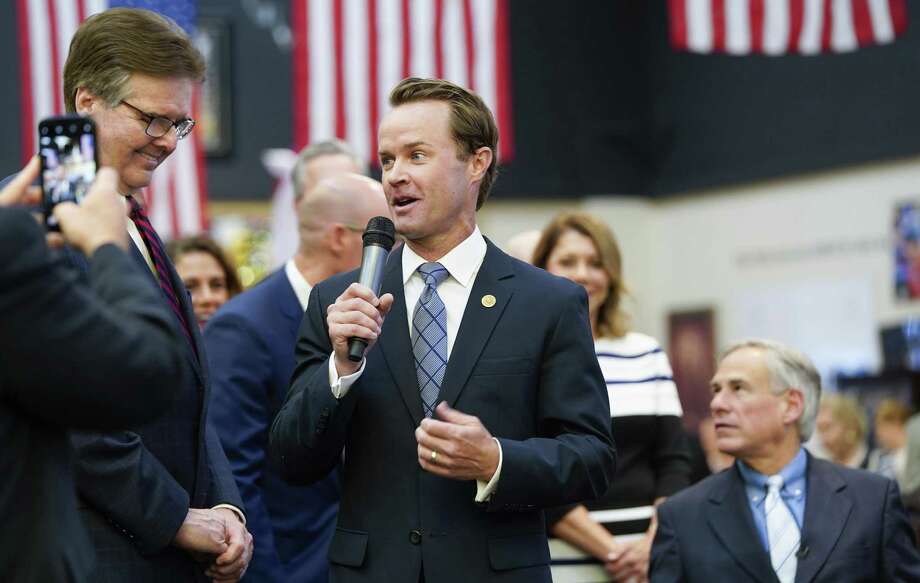
Note: We had originally planned to crop this photo to only
show Patrick and Phelan, but Abbott being irrelevant in the
 background is likewise apt.

"Show us Your mercy, Lord,
And grant us Your salvation."
Psalm 85:7

The biannual boomlet of "will Texas or won't Texas legalize marijuana this session?!?" has started. This time, it's accompanied by a subplot related to the budget. Allow us to cut to the chase.

Dan Patrick is still the Lieuentant Governor.

So, no. Marijuana legalization isn't happening. LOL.

That being said, if he's smart enough to take it, there's an opportuity for Patrick.

It's not a secret that Patrick has recently taken a tactical retreat on school choice. That house hasn't left him any option. But, if the house wants to try and force Dan Patrick to do something he doesn't want...well...two can play at that game.

Besides, in the extraordinarily unlikely chance the house were to agree to it, that would be a good trade.

Bottom Line: There's nothing Patrick can lose. There's potentially something he can gain. No brainer.

Saturday, January 11, 2020

#atxcouncil, #TXLEGE: A Predictable Response to the Legislature's Incompetent Policymaking


"He who is slothful in his work
Is a brother to him who is a great destroyer."
Proverbs 18:9

From the department of completely unsurprising developments:
As Texas law enforcement grapples with how to determine whether a substance is marijuana after lawmakers legalized hemp last year, one city’s officials are putting forward their own solution: effectively decriminalize possession of small amounts of pot altogether.

The Austin City Council will vote on a proposal later this month that, if approved, would “virtually end arrests and fines” by city police for possession of personal amounts of cannabis, according to a summary and copy of the measure obtained by The Texas Tribune.

The resolution, raised by four progressive members of the 11-member council, would largely direct police to stop arresting people or issuing citations in low-level marijuana possession cases in which officers won’t be able to get lab reports to chemically distinguish between now-legal hemp and illegal marijuana. It also would forbid the city from spending funds or using its personnel to perform such tests.
There's a lot that can be said about the wisdom of this development.  It might or might not be a good idea.  But there's a more important question: What did you expect?!?

Because the die on this one was cast last summer, when the Legislature botched the hemp bill.

As we said last July:
Obviously, this story is amusing. The stoner jokes write themselves. Furthermore, the policy outcome is one this author has long supported.

That being said, there is a serious angle to this story: Legislative sloppiness.

While the hemp/marijuana slip up is humorous, the policymaking environment that enabled it is NOT.

The legislature routinely passes massive, complicated, bills without having a clue what they'll actually do. Sometimes those bills have real world consequences. Unfortunately, half-assed policymaking is a predictable consequence of the legislature's culture of entitlement.

[Note: Emphasis in original.]
When the legislature's half-assed policymaking creates a gigantic loophole in the law, it should surprise nobody when Greg Casar drives a Mack truck through it.

If the state of Texas doesn't like it, the Governor can call a special session.

Cuz' this is their own damn fault.

Like it or not.

Bottom Line: The State of Texas could fix this legal loophole in 30 minutes if there was political will to do so.  There isn't.  Like it or not, Casar's action has all the legal justification it needs.

Monday, July 8, 2019

#TXLEGE: This hemp/marijuana mix-up illustrates MUCH DEEPER Problem with Legislature


"He who is slothful in his work
Is a brother to him who is a great destroyer."
Proverbs 18:9

Statesman has a really good editorial on this industrial hemp/marijuana situation:
In their enthusiasm this legislative session to open up Texas fields for hemp farming, lawmakers ended up sowing a bumper crop of confusion among police, prosecutors and the public.

Now hundreds of marijuana cases are getting dropped across the state, and Texans are receiving mixed messages: Pot remains illegal, but you may or may not get charged for having it, depending on which county you’re in.

It’s the kind of bungled plot we’d expect from a stoner movie, not the state Capitol.

Legislators and Gov. Greg Abbott failed at one of the most basic aspects of passing a law: Making sure the tools exist to enforce it. In this case, House Bill 1325 by Rep. Tracy King, and sponsored by Sen. Charles Perry, defined legal hemp as having less than 0.3% of tetrahydrocannabinol or THC, but no one checked to see if police labs around the state were equipped to distinguish hemp from marijuana, which has a greater concentration of the euphoria-inducing THC.

Turns out, most agencies don’t have such testing available.

For years, law enforcement relied on simple field tests and drug-sniffing dogs to detect the mere presence of THC, not a certain concentration of it. Prosecutors also relied on the testimony of experienced officers that the substance they seized was consistent with marijuana. All of that is out the window now, because none of those methods can distinguish lawful hemp from outlawed pot.
Obviously, this story is amusing. The stoner jokes write themselves. Furthermore, the policy outcome is one this author has long supported.

That being said, there is a serious angle to this story: Legislative sloppiness.

While the hemp/marijuana slip up is humorous, the policymaking environment that enabled it is NOT.

The legislature routinely passes massive, complicated, bills without having a clue what they'll actually do.  Sometimes those bills have real world consequences.  Unfortunately, half-assed policymaking is a predictable consequence of the legislature's culture of entitlement.

Bottom Line: Routine failures at the basic blocking-and-tackling of legislating should disgust all Texans, even if the outcome in this specific case was funny.

Tuesday, May 28, 2019

#TXLEGE: Not "worst session ever" (but still pretty dadgum uninspiring)


"Let us search out and examine our ways,
And turn back to the Lord;"
Lamentations 3:40

[Note: #TXLEGEwatch has a detailed examination of the session here.]

The 86th is over.  Some say it accomplished nothing, while others claim Texas just won the Super Bowl.  Both hyperbolize.

The truth lies between (though significantly closer to the former).

To call the legislature's results on property taxes and school finance "transformational" is silly.  They are, however, meaningful progress.  Just because legislators exaggerate does not change the fact that automatic rollback elections and automatic tax compression are reforms for which some people have fought for decades.

So one (possibly one and a half) cheer for the legislature.

That being said, they didn't deliver squat on any other major issue.  On medium tier issues (eg. marijuana reform), the pickings are likewise slim.  Minor accomplishments (eg. the so-called 'Born Alive' act) are spun into 'major' victories.

It reminds us of what a former Governor of Texas once said about the "soft bigotry of low expectations."

Bottom Line: White-hot rage is an overreaction, but a bright-orange sense of EXTREME irritation is entirely appropriate.

Thursday, June 21, 2018

#atxcouncil: Casar's so-called "Freedom City" plan isn't a big deal (Republican hysteria notwithstanding)


"He who passes by and meddles in a quarrel not his own
Is like one who takes a dog by the ears."
Proverbs 26:17

Last week, while we were at convention, council passed a largely symbolic measure:
Amid the controversy over sanctuary cities, Austin this month took its fight against strict immigration law enforcement a step further by declaring itself to be the first “freedom city” in Texas. City Council members unanimously passed two resolutions last week that will restrict police attempts to question immigrants about their status and curtail arrests for nonviolent crimes.

One of the new city resolutions requires officers who question immigrants about status to also say that their questions about immigration need not be answered. The other resolution directs police to avoid arrests for misdemeanors, including those for smoking marijuana, having drug paraphernalia, and taking part in petty theft — crimes that city data shows frequently end in arrests of black and Latino residents.

....

“Poor people of color in our city are over-punished and over-incarcerated,” said Greg Casar, an Austin City Councilman who pushed for the resolutions. “If people are being arrested less, we can also prevent people from being put in the deportation pipeline.”

“We found that black and Latino residents comprised 75% of discretionary arrests for driving with licenses invalid in the city even though they are 45% of the population of the city,” Casar said. “Black residents are seven times more likely to be arrested for low-level marijuana violations despite having comparable rates of usage of marijuana to white residents.”

Casar said the new rules could prevent up to 1,000 low-level arrests each year. Austin police arrest around 30,000 people a year.
The new policy has two parts: An immigration component and a marijuana component.

-------

On immigration: The new policy stays well within the legal constraints of SB 4.  All the policy requires is that, if an APD officer wants to pursue a line of questioning related to federal immigration issues, the officer has to inform the suspect that the suspect has the right to remain silent.  That's it.

Guess what?!?  Under the 1966 U.S. Supreme Court ruling Miranda v. Arizona, EVERY.  SINGLE.  PERSON. arrested in the United States is already informed of their right to remain silent.  All the City of Austin's new policy states is that, if an APD officer wants to pursue immigration related questioning, the suspect must be "Miranadized" twice.

That's it.

[Confession: As someone who locks wits with Greg Casar on a fairly regular basis, we're impressed with how he's trolling the intent SB 4 while staying well within SB 4's letter.]

-------

On marijuana: The new policy does nothing but discourage arrests for low level possession offenses (aka. decriminalization).

Well...guess who just endorsed marijuana decriminalization?!?

From the 2018 Platform of the Republican Party of Texas, Plank 107:
Civil Penalty: We support a change in the law to make it a civil, and not a criminal, offense for legal adults only to possess one ounce or less of marijuana for personal use, punishable by a fine of up to $100, but without jail time.
Soo...the City of Austin just adopted a policy that's consistent with the platform the Republican Party of Texas adopted last week.

-------

Nevertheless, hysteria:


You're joking, right?!?

The city's new policy may or may not be wise, but the notion that it's a threat to public safety is silly.

Austin Texas is one of the safest cities in the country.  Despite having the fifth largest population in Texas, we're #17 in crime.  The notion that "double-mirandizing" immigration suspects and de-prioritizing marijuana arrests will change that reality is, once again, silly.

But what do we know?!?  We only live in a 70% Hispanic neighborhood in East Austin....

Don't get us started on the ridiculous e-mails we've received.

-------

It's also worth pointing out that we vetted this proposal two weeks ago.  We didn't see anything (major) wrong with it then, and none of the silliness we've seen since then changes our mind.  But nice of the rest of y'all to belatedly figure out this was happening.

-------

Then there's the fact that, by reducing the number of arrests, the new policy might actually save money.

-------

Bottom Line: Priorities people.... 
Monday, July 18, 2016

Jason Isaac talks sense on Marijuana reform


"He has shown you, O man, what is good;
And what does the Lord require of you
But to do justly,
To love mercy,
And to walk humbly with your God?"
Micah 6:8

Good for him:
Texans who are arrested for possessing small amounts of marijuana shouldn’t be locked out of jobs and haunted by minor lapses in judgment for the rest of their lives, business and legislative leaders say.

As acceptance of marijuana — medical and otherwise — grows nationally and in Texas, members of both major political parties in the Legislature have staked out positions supporting the decriminalization of possession of small amounts of marijuana. The proposed change could be beneficial for Texas businesses, proponents have said.

State Rep. Jason Isaac, R-Dripping Springs, told the American-Statesman that too many Texans have missed out on jobs because of criminal records that involve nonviolent drug charges. Isaac said he plans to support decriminalization bills in the upcoming legislative session, which will begin in January, to make sure more Texans can get jobs and not face a lifetime with the stigma of a criminal conviction.
Read the whole thing here.

Thursday, June 9, 2016

State Bar places Jana Duty ON PROBATION!!!


"For the mouth of the wicked and the mouth of the deceitful
Have opened against me;
They have spoken against me with a lying tongue."
Psalm 109:2

The awful outgoing Williamson County DA, who first came to our attention when she tried to send some poor kid to prison for life for a couple pot brownies and subsequently got busted suppressing evidence in a capital murder trial, has gotten a small taste of what she so richly deserves:
The State Bar of Texas has placed Williamson County District Attorney Jana Duty on probation for 18 months. Duty will still be able to practice law but will have to comply with the terms of her probation. She was not immediately available for comment Monday.

The probation is for professional misconduct in connection to the Crispin Harmel case, according to a probated suspension judgment from the State Bar. It put Duty on probation starting June 1 and ending Nov. 30, 2017, according to its website.

A district judge ruled that Duty had withheld evidence in the case that ended in a mistrial.

[h/t: Lawerence Person's Battleswarm Blog]
Truthfully, she deserves far worse, but this is a start; read the whole thing here.

Duty lost in the March primary to (Cahnman's Musings endorsed) Shawn Dick; Dick will assume office in January.

Monday, January 25, 2016

David Simpson: God and Governing


"Do not strive with a man without cause,
If he has done you no harm."
Proverbs 3:30

David Simpson spoke with the Trib last fall about the intersection of scripture and civil government:


Highlights:
  • "We only really need government when we don't use that Freedom responsibly and we harm our neighbor."
  • "Under the new covenant, I don't think we even need civil government."
  • "Most sins are self-correcting."
  • "We're not made to be robots, we're not to be slaves, we're to be free and responsible independent human beings."
  • "When I do talk about my Christian convictions it's usually to speak to other Christians, because many times they are conservatives but they just want to take the gun out of the liberal's hands and turn it on them, and I want to take the gun out of everybody's hand and lay it on the table and have a voluntary discussion."
  • "The only time we should really use force is when you commit aggression."
  • Influence should be through discourse, not coercion.
  • "I don't think you should have to have a licence from the government to defend yourself in the means that you think is best."
  • Pot is a plant, compared to the chemical substances uses to make hard drugs.
  • Death Penalty has a place "when you commit aggression."
  • Sex Ed: "I think it should be taught at home."
  • "I did not support government's expansion to pre-K."
  • "Government is not our savior."
  • "One of the problems right now with the border is the drug war, and until we solve the drug war, we're going to have a porous border."
  • "Churches should do much more that the government is doing today."

Saturday, February 7, 2015

RPT Chairman Debate


"And let them judge the people at all times. Then it will be that every great matter they shall bring to you, but every small matter they themselves shall judge. So it will be easier for you, for they will bear the burden with you."
Exodus 18:22

Euless, TX -- This morning, the four declared candidates to succeed outgoing RPT chair Steve Munisteri held a forum in Tarrant County.  The candidates discussed a wide range of topics, from enforcing the party platform to RPT involvement in local races.  View the forum below:

[Author's Note: The forum starts at the 17:00 mark of the first video]


Highlights:

Mechler opening statement:

  • It's about fighting tyranny.
  • The best way to ensure success is to keep the current team in place.
Woodfill opening statement:
  • How do we continue to grow these majorities?!?
  • 62-65% victories is the goal.
  • Take economic AND social issues into non-traditional R communities.
  • Proud of platform, don't water it down.
  • 4 GOP county sweeps in 6 terms as Harris County chair.
Armstrong opening statement:
  • Push socially and fiscally conservative message in the marketplace.
  • Get churches out to vote.
  • Use marriage issue for African-American outreach.
Emmert opening statement:
  • Long-winded recitation of his Christian CV as a preamble for why the RPT should throw social conservatives under the bus.
Medical Marijuana:
  • Emmert against "but will keep an open mind."
  • Armstrong no: "Widespread use is destructive."
  • Woodfill: Completely opposed, lame straw-man argument about gateway drug and people going to work stoned.
  • Mechler has voted yes in past.
Local elections:
  • Woodfill: "ABSOLUTELY" get RPT involved in local elections.
    • Cites his work fighting Annise Parker.
    • Referendum process and attack on pastors.
  • Armstrong echoes and praises Woodfill.
  • Mechler: Local elections are non-partisan in name only.
Platform enforcement:
  • Woodfill: Chair needs to be actively involved in legislative process.
  • Mechler: RPT should be a lobby for state convention delegates.
  • Armstrong: Helped smack down Rick Perry after HPV mandate.
"Factions":
  • Woodfill: Unify around party platform.
    • A lot of the time, "unity" is code for telling SoCons to shut up.
Minority engagement:
  • Woodfill: Af-Am and Hispanic pastors were some of the closest allies in the fight against Annise Parker.
  • Armstrong: Social issues are vitally important.

Tuesday, January 6, 2015

Dallas and Tarrant County welcome Scott Turner


"You are the salt of the earth; but if the salt loses its flavor, how shall it be seasoned? It is then good for nothing but to be thrown out and trampled underfoot by men."
Matthew 5:13

Scott Turner spoke last night in Grand Prairie.  Due to technical circumstances, we couldn't attend.  His remarks below:


Highlights:

  • "I'm just a former dishwasher...."
  • "Politics is a big boy game."
  • It doesn't take long "to figure out that something isn't right" in Austin.
  • "Do we really bring salt and light into our culture today?!?"
  • "I love old school, how 'bout you?!?"
  • "We talk about border security" but it gets held up by House leadership.
  • "We don't have to raise fees and taxes in order to fund transportation, you know transparency in TxDOT, that's a good start."
  • Current leadership kills school choice.
  • "We've got a $200 billion budget...which doesn't have transparency."
  • Move from "strategies" based budgeting to programs based budgeting.
    • Personal Note: We've been following the Texas Legislature for YEARS at this point and we still don't understand what 'strategies based budgeting' means...but of course that's the point.
  • Repeal Margins Tax.
  • "People are tired of backroom deals."
  • Lists top 5 priorities at 34:30.
  • The medical marijuana people continued trolling.
  • Ray Myers: "On the 13th, they're going to have to tell us who they are."

Friday, January 2, 2015

Government Employees vow to defend Drug War gravy train


"He has shown you, O man, what is good;
And what does the Lord require of you
But to do justly,
To love mercy,
And to walk humbly with your God?"
Micah 6:8

More accurate headline:
The Texas Sheriff's Association says it will fight hard to block efforts in the upcoming Legislative session to decriminalize the possession of small amounts of marijuana, demonstrating that the move toward lighter punishments for pot possession are not 'inevitable,' as supporters claim, News Radio 1200 WOAI reports.

"The Sheriff's Association position is that we are going to oppose any effort to decriminalize marijuana, or legalize medical marijuana or any of the components of marijuana," Brazos County Sheriff Chris Kirk told News Radio 1200 WOAI. "Of course, we will vigorously oppose any effort to legalize marijuana."

A bill to turn possession of less than an ounce of marijuana into essentially a parking ticket, with a fine of no more than $100, has been introduced in the session that begins January 13th. No marijuana legalization bill has been introduced.
Read the whole thing here.

-----

Update: The Daily Caller has more here.

-----

Update II: This facebook comment thread is illustrative of the views of most Texas Conservatives....


Friday, November 7, 2014

Texas Drug Warriors destroy family and kill small child


"For such are false apostles, deceitful workers, transforming themselves into apostles of Christ. And no wonder! For Satan himself transforms himself into an angel of light. Therefore it is no great thing if his ministers also transform themselves into ministers of righteousness, whose end will be according to their works."
2 Corinthians 11:13-15

Reprinted in full:
Little Alex Hill would have been turning four-years-old this Friday. But rather than celebrating their child's birthday, the toddler's parents have only the bitter consolation of seeing a judge in Milam County hand Alex's foster mother a life sentence for murder.

The life sentence is a small victory in the case of 2-year-old Alex, whose July 2013 death was caused by devastating injuries at the hands of her foster mother, 52-year old Sherill Small.

Alex was placed in Small's care in early 2013, after her father admitted to child welfare investigators that he had smoked marijuana while the child was tucked away in bed at night.


By all accounts, towheaded Alexandria "Alex" Hill, was a healthy and happy toddler, living with her parents, Joshua Hill and Mary Sweeny, in Cameron, Texas in late 2012. But in Texas, using cannabis goes against child welfare policy, and Hill, who told investigators he'd been smoking pot at night, was in violation of those laws.

"Mr. Hill admitted to smoking marijuana in the house when his daughter has been upstairs sleeping," the caseworker representing the Texas Department of Family and Protective Services noted in court records.

The CPS caseworker ultimately determined that Alex's mother's frequent seizures (a medical condition), coupled with that pesky marijuana use, warranted removal from the home, and Alex was placed with a foster family.

marijuanapolicy.jpg
But Alex's parents immediately began to notice red flags about the conditions in the first home during visitations with their daughter, according to Hill. Alex had noticeable bruises, and the couple also found mold & mildew in the little girl's bag.

See Also:

Medical Marijuana Refugees Are Fleeing Texas to Help Their Loved Ones
These Cannabis Bills Could Change Toking in Texas for Good


Fearing for her safety, Hill refused to give Alex back, despite the threat of jail time, unless the state placed her in a different home. The placement agency ultimately gave in, and Alex was placed in her second foster home, this time with Sherill Small, who had one other child in her care.

Small had been approved as a foster parent by Texas Mentor, a third party private agency who provides foster homes to the Texas Child Protective Services system. No mention was made of Texas Mentor's shady track record -- they had racked up over 15 violations by this point, according to the Dallas Morning News.

114 more violations would ultimately follow, but none of this information was shared with Hill. The first time he heard it, he was sitting in the courtroom listening to testimony on Alex's beating death.

On July 29, 2013 -- just four months before Joshua Hill was set to regain custody of his daughter -- he received an urgent call requesting that he rush to the Scott and White Children's Emergency Hospital in Temple.

When Hill arrived, he found his daughter attached to machines, with Alex's tiny body kept alive on life support. Her father had no choice but to say goodbye.

Ultimately, Small admitted to Rockdale police that Alex's injuries came from her slamming the toddler onto the floor of the home where she lived with her husband, Clemons Small III.

But it was an accident, Small said, one that happened when she was "playing a game" with the child. Still, she admitted to being "frustrated" with the girl because the the toddler had woken up early that morning to get herself food and water.

While the idea of removing a toddler from her parents' care not for abuse, but for simple marijuana use, is puzzling at best, what's even more disconcerting is that the same rules didn't apply to her foster family.

Turns out Sherill Small's third husband, Clemon Small, had a pretty legit criminal history, including multiple drug charges for marijuana.

During the home study portion of the couple's foster application, Clemon described himself as a recovering crack cocaine addict, and admitted to multiple drug charges. Small also admitted to the home study investigator that she had also been out of work for months. Rather, she made a living by keeping foster children.

Still, the report from the home study concluded that "the family is capable of providing a safe home environment," and Small was given the go ahead to provide foster care.
That "safe environment" is where Alex died. A medical examiner found that her head hit the floor so violently that she was found to have "subdural hemorrhaging, subarachnoid hemorrhaging, and retinal hemorrhaging in both eyes," according to court testimony.
Alex's autopsy also revealed several bruises and injuries on her cheek, arms, legs, and behind her ear, he said. The most severe bruising was found on top of the head and around Alexandria's lower back and buttocks.

Court testimony in the case stated that Alex had also lost about a third of her total blood volume from her liver, preventing oxygen from reaching her brain and causing liver function to fail.

Not only is it stunning the state would allow kids to be placed with such foster parents. Alex's case also begs the question as to why investigators must remove a child whose parents smoked pot -- while she was tucked a way in bed upstairs -- in the first place.
While the state of Texas may still have antiquated marijuana policies on the books, other states sure don't. Recreational and medicinal pot is, as of Tuesday's election, legal in four states -- Alaska, Oregon, Washington and Colorado -- along with the nation's capitol, Washington, D.C., and one city, South Portland, Maine.

See Also:

Texas Man No Longer Faces Life in Prison for Pot Brownies
Cannabis, Texas: How Close Are We to Legalization in the Lone Star State?


Medical marijuana is legal in 23 states, there is pending legislation in two more -- Ohio and Pennsylvania -- and 14 other states tried, albeit unsuccessfully, to pass medical marijuana legislation in 2014.

Alex died a brutal, untimely death because she was placed in a dangerous foster home. But she put in foster care in the first place because the state of Texas deemed it reasonable to remove her from a loving home because her father smoked pot while she was asleep.

That seems like too high a price to pay for pot prohibition.

Wednesday, September 17, 2014

Tan Parker talks sense on Marijuana policy


"He has shown you, O man, what is good;
And what does the Lord require of you
But to do justly,
To love mercy,
And to walk humbly with your God?"
Micah 6:8

Zowie:
This election season our newspaper added two questions on drug policy to questionnaires we sent candidates for state offices. Rep. Tan Parker, R-Flower Mound, surprised me with his answer on whether he’d support putting a medical marijuana amendment on the ballot for voters to decide.

Parker said he’d be open to a tightly written medical marijuana amendment.

Further, in an interview with the editorial board yesterday (along with his Democratic opponent, Daniel Moran, a UNT student), Parker said he would support legislation eliminating jail time for possession of small amounts of marijuana. His position reminded me of Gov. Rick Perry’s statement this year that, “You don’t want to ruin a kid’s life for having a joint.”
Read the whole surprisingly sensible thing here.

Monday, September 1, 2014

#ThirdWorldPractices: Greg Abbot proven right (again)....


"But You, O God, shall bring them down to the pit of destruction;
Bloodthirsty and deceitful men shall not live out half their days;
But I will trust in You."
Psalm 55:23

First, this has happened before. Second, Hidalgo County is the epicenter of the current crisis. Third, great find from Breitbart Texas:
A developing federal investigation has brought up allegations that a Hidalgo County Commissioner paid for votes with bags of cocaine while other politicians paid for votes also with cash, cigarettes, marijuana and beer.

Court records obtained by Breitbart Texas from the arrest of two women accused of buying votes show that during the democratic primaries in 2012, a campaign manager for a Hidalgo County Commissioner who said that during the campaign, he bought $50 worth of cocaine, commonly known as an 8-ball and split it up in order to give it to the two women so they could use it to entice voters.

Earlier this week Belinda Solis and Veronica Salazar went before U.S. Magistrate Judge Peter Ormsby who formally charged them with vote buying and set their bond at $10,000.

The two women were part of a large year and a half long FBI investigation into election corruption in Hidalgo County.

The investigation began in January 2013 when agents met with a campaign manager for a Hidalgo County Commissioner, who told the agents that he bought cocaine so his campaign workers could give it to the voters in exchange for their votes. The court records do not identify the commissioner by name; however they state that he ran during the 2012 primaries. The women were paid campaign workers, also known as politiqueras, who targeted low income areas and elderly individuals enticing them to vote for a particular candidate.

Over the course of the investigation, agents met with the two women who told the agents that they had received the cocaine from the campaign manager who is only identified on court records as campaign worker 1 and then gave it to the voters. The women also told the agents that they gave cocaine to voters during the school board election in Donna ISD in addition to cash, beer, cigarettes, and marijuana.
This has a long history.   It's gotten worse during the current crisis.  Kudos to Greg Abbott for accurately describing the situation.

Friday, August 15, 2014

A Surprisingly Realistic Strategy for Marijuana Legalization


"He has shown you, O man, what is good;
And what does the Lord require of you
But to do justly,
To love mercy,
And to walk humbly with your God?"
Micah 6:8

This week's San Antonio Current documents the maturation of the pro-pot legalization movement in Texas:
“So many of our legislators have been tough on crime and for them to start thinking outside of that, you have to think about sales,” Fazio said of her strategy. “We have to paint a picture and tell the story of how it looks when adult business owners are providing the product for the market where there’s a demand for it, the different aspects of the business and the economic incentives to want to do this.”

As for providing a glimpse of the economic incentive of legalized marijuana, Fazio wants people to look west. “Absolutely, there’s that economic incentive,” Fazio said, referring to Colorado’s tax revenue from marijuana. “But of course, in Texas, we like to say we are fiscally conservative and that money should be kept in the hands of people. Colorado’s tax rate is over 35 percent on recreational marijuana and it’s a significant rate of taxation.” According to the Colorado Department of Revenue, there’s a 10 percent sales tax on marijuana products that is coupled with a preexisting 2.9 percent state sales tax, plus local jurisdiction taxes and a 15 percent excise tax on wholesale marijuana. In Denver, according to a November 6, 2013, story in the Denver Post, those factors equate to a 29 percent tax on retail marijuana sales. In May 2014, the state collected a little more than $5.7 million in taxes, licenses and fees. So far for the year, nearly $34.9 million in pot tax dollars have poured into the state’s coffers, according to the Colorado Department of Revenue.

That’s a lot of money, and Fazio would like to see Texas stick to its idealogical guns and avoid such a heavy tax burden. “I’d really love Republicans to see that using limited government ... can set an example for what minimal regulation and taxation can do for business owners and the economy,” Fazio said of allowing legal marijuana businesses in Texas.

It seems that some Texas Republicans are ready to start talking, though they might still be drowned out by louder, more established voices. The Texas Republican Party’s 2014 Temporary Platform Committee report included pro-medicinal marijuana language in its Healthcare and Nutritional Supplements section. “We support the rights of all adults to their choice of nutritional products and alternative health care ... We urge the Texas Legislature to allow, encourage and facilitate the study at our Texas medical schools [concerning] the safety and efficacy of medical cannabis,” the draft report stated. In the first minority report, several committee members recommended changing the wording of that platform to read as “We believe that Texans should have legal access to medical cannabis as a controlled narcotic prescribed by a physician.” But another minority report recommended removing all language about medical marijuana from the party platform for the 84th Legislature. In the final version of the party’s platform, all language about cannabis had been removed from the health care and nutrition section.

Yet even Governor Rick Perry seems to have warmed to changing the marijuana laws in Texas. Back in January during a panel on drug policy at the World Economic Forum in Davos, Switzerland, Perry said that states should be able to make their own decisions when it comes to marijuana legalization.

“As the governor of the second-largest state in the country, what I can do is start us on policies that can start us on the road towards decriminalization,” Perry said, while demurring from discussing full legalization.

Fazio said Perry’s statements have loosened up conservative legislators and given them the green light to have a conversation about marijuana policy in Texas. “It’s OK to start talking about how we can reform our laws to better serve the people of Texas and I appreciate that he got pressed on the issue and that he didn’t avoid it,” Fazio said. “It’s great that the conversation is being had about reforming laws to make society better in a very significant way. Prohibition of alcohol was so negative, and that was [for] 13 years. We’ve seen decades of horrible marijuana prohibition and now we get to right that wrong.”

Will Texas legalize by 2019?

It’s these shifting attitudes throughout the nation and even within conservatives in Texas that prompts the Marijuana Policy Project to lobby hard on every aspect of marijuana legalization.

“What we see across the country is a sweeping change where people are finally putting it into policy. The fact is, prohibition has failed and we need to repeal it. Texas is not going to be the last state that legalizes marijuana,” Fazio said. “The goal is to have full legalization by 2019, with an open legal market that is similar to alcohol.” Fazio said.

The Marijuana Policy Project will lobby to introduce three bills in 2015 that would legalize medical marijuana, decriminalize pot by setting civil penalties with no opportunity for jail time, or—of course—fully legalize marijuana for recreational use and state regulation, Fazio said.

Last September, Public Policy Polling, which polls for the Democratic Party and other progressive organizations on a private basis, conducted a three-day poll of 860 Texas voters. According to the data it published, 41 percent of voters polled strongly supported full marijuana legalization in Texas and 24 percent were strongly opposed. Seventeen percent of voters somewhat supported full legalization and 14 percent were somewhat opposed. As for legal medicinal marijuana in the Lone Star State, 58 percent of voters supported it and 31 percent were opposed. The largest percentage of Texas voters supported decriminalization with 61 percent siding with the notion and 30 percent of voters opposing decriminalization. The 860 voters included 42 percent who registered as Republicans, 35 percent who registered as Democrats and 23 percent who registered as independents or other. Karli Christine Duran, founder and Executive Director of the San Antonio chapter of the National Organization for the Reform of Marijuana Laws (NORML), thinks attitudes toward marijuana are rapidly evolving.

[Author's Note: Emphasis added.]

....

And support for medical marijuana is starting to come from unlikely places. According to Fazio, who attended a veterans conference in mid-July, military veterans are increasingly claiming publicly that medicinal marijuana treats Post Traumatic Stress Disorder (PTSD), which afflicts many men and women returning home from war.

This brings out other veterans and veteran advocates searching for alternatives to addictive pharmaceutical opiates for sufferers of chronic mental and physical distress. Those interested in service member suicide prevention are also looking to marijuana’s possible psychotropic benefits.

According to the Veterans for Medical Cannabis Access, Israeli doctor Raphael Mechoulam’s research on mice has shown that marijuana may reduce the association between stimuli like loud noises or stress and traumatic situations in veterans suffering from PTSD. Mechoulam discovered the psychoactive compound in marijuana, along with other breakthroughs related to cannabis throughout his career. And in a recent Texas Monthly article, William Martin, a Harry and Hazel Chavanne senior fellow in Religion and Public Policy and director of the Drug Policy Program for Rice University’s Baker Institute for Public Policy, interviewed numerous Texas military veterans who said marijuana not only treated their PTSD symptoms, it changed their quality of life for the better—despite their fear of arrest.

....

[Prohibition] “causes too many people doing no harm to acquire a permanent label as a criminal; it costs too much in arrests, jail, probation and other expenses; it provides an illegal and profitable market to Mexican and other criminal drug trafficking operations; it corrupts various levels of the justice system; and it doesn’t work. How’s that for starters,” William Martin wrote via email when asked if there is anything wrong with current marijuana policy in the Lone Star state.

Fazio and Duran concur. “Law enforcement is one of our biggest opponents and it has a lot to do with the funding they get for enforcing drug laws. It’s the culture. Law enforcement has it engrained in them that they have to go after this,” Fazio said. “There’s that strong Texas culture of being tough on crime. The reality is repealing prohibition would allow us to use limited resources effectively in serving victims of real crimes and protecting people.” Duran added that the arrest, prosecution and incarceration of people accused of possession of small amounts of marijuana contribute to jail overcrowding and at a significant cost to taxpayers. “Once prosecution starts and you go through the court and all that stuff, you’re tacking on thousands more,” Duran said of the cost to taxpayers when prosecuting marijuana misdemeanors.

While acknowledging that marijuana is a psychoactive drug that can have negative effects, particularly with heavy use, Martin doesn’t think that’s enough of a reason for Texas’ current draconian marijuana laws. “It is far less dangerous, personally and socially, than alcohol. There is simply no convincing justification for treating its use as a crime,”
 Read the whole thing here.

-----

Some thoughts:
  • This plan addresses the biggest challenge regarding legalization: Using it as a smokescreen for tax increases; while this website strongly supports marijuana legalization, we oppose new taxes even more strongly.
  • 2019 [aka. Abbott's second term] is a realistic timeline that won't impede higher priority economic legislation in the coming two sessions.
  • We had no idea medical marijuana was showing progress for vets with PTSD...muy bueno!!!

Tuesday, June 10, 2014

Jana Duty destroys another life


"He has shown you, O man, what is good;
And what does the Lord require of you
But to do justly,
To love mercy,
And to walk humbly with your God?"
Micah 6:8

Remember Jana Duty?!?  She's authoritarian Williamson County DA most recently seen endorsing Dan Branch.  Looks like she's up to her old tricks:


Highlights:
  • It's not about marijuana, it's about another form of the same drug.
  • The weight of the chocolate is part of the "weight" of the illegal substance: "The weight of the chocolate including the Tupperware container was a little more than 50 grams. That's enough for a second degree felony charge. It nets two to 20 years in prison."
-----

Concerned citizens can contact Williamson County D.A. Jana Duty:
Email: jana@janaduty.com
Phone: 512-554-5678

Tuesday, May 27, 2014

Psychotic Authoritarian Drug Warriors for Dan Branch


May the Lord cut off all flattering lips,
And the tongue that speaks proud things,
Psalm 12:3

Last week, we told you about Williamson County District Attorney Jana Duty, who's attempting to lock up a 19 year old kid for life over a couple of pot brownies; look who she's supporting for Attorney General:


That Dan Branch chooses to broadcast an endorsement from an out of control District Attorney currently ruining a 19-year-old kid's life tells you everything you need to know about Dan Branch.

Wednesday, May 21, 2014

Miscarrying Justice in Williamson County


"He has shown you, O man, what is good;
And what does the Lord require of you
But to do justly,
To love mercy,
And to walk humbly with your God?"
Micah 6:8

"I will bring honesty and integrity back to the D.A.'s office and seek justice above all else."
Williamson County District Attorney Jana Duty, Campaign Website [emphasis added]

This is outrageous:


Highlights:

  • Hash oil is listed as a more serious offense under Texas law that regular pot.
  • "A sexual assault or a manslaughter carries a maximum of twenty years, he's looking at much more than that."
  • "Linked to the weight of the substance found, including any adulterants or dilutants.
    • i.e. The weight of the brownie mix was factored into what he was charged with.
  • You can have over 100 grams of pot and it's still a misdemeanor, but over a gram of hash oil and its a felony.
-----

Concerned Citizens can contact Williamson County District Attorney Jana Duty:

Email: jana@janaduty.com
Phone: 512-554-5678

-----

It gets better, WillCo D.A. actually ran for office on a platform of protecting citizens against prosecutorial abuse:

Tuesday, February 18, 2014

Stickland channels Cruz


Hurst, TX -- In front of a packed house of 400 people, tonight's HD-92 debate between conservative incumbent Jonathan Stickland and educational bureaucrat Andy Cargile was a one-sided affair similar to the 2012 U.S. Senate race.

Stickland delivered a crisp and energetic performance worthy of Ted Cruz.  Speaking without notes or prepared remarks, Stickland explained how he went to Austin to fight the liberal agenda and "I did exactly what I said I'd do."  It was obvious why the business as usual crowd in Austin hates his guts.

Playing Dewhurst to Stickland's Ted Cruz was the befuddled, ill-prepared, and poorly-informed Andy Cargile.  Cargile opened the debate by drawing a bizarre comparison between Stickland and Barack Obama: "when you get a lot of words and no action, you get Barack Obama."  Cargile's statement ignores the fact that from Obamacare to an illegal and unconstitutional War in Libya to countless other examples, Obama has delivered plenty of action (none of it good).

Cargile's strangest moment in the debate was his assertion, during the discussion of immigration, that there are no sanctuary cities in Texas.  Stickland politely reminded Cargile that both Austin and Lewisville are sanctuary cities (he didn't mention Houston).  That Cargile didn't know such a basic fact speaks volumes.

The most telling contrast was each's description of his view of his role as a legislator.  Cargile called a seat in the Texas House "the next step" in his career.  Speaking second, Stickland pounced: "I don't define myself by my position" as a member of the legislature.

Another illuminating moment was the discussion about a more rational policy towards low-level marijuana offenses.  Cargile embraced prohibition with a Joe Biden-esque level of zeal.  Cargile attacked Stickland for voting against a bill last session that would ban so-called "synthetic" Marijuana.  In his well-informed response, Stickland rejected the premise of the legislation and simultaneously explained that the legislation in question would have criminalized a plant that grows naturally on the grounds of the Texas capitol.

Tonight's debate wasn't close.  Stickland delivered a sharp performance similar to Ted Cruz.  Cargile was fumbling at best.  By the end, a quarter of Cargile's supporters were quietly applauding Stickland.  If this was a Little League game, they would have invoked the mercy rule after ten minutes.

Saturday, February 1, 2014

Rick Perry, Marijuana, and our first conversation


[Author's Note: This picture was taken at the 2010 event described below.]

He has shown you, O man, what is good;
And what does the Lord require of you
But to do justly,
To love mercy,
And to walk humbly with your God?
Micah 6:8

Last week, in Davos, Rick Perry made a comment about marijuana that ignited a media firestorm:
“As governor, I have begun to implement policies that start us toward a decriminalization” by introducing alternative “drug courts” that provide treatment and softer penalties for minor offenses"
The only noteworthy aspect of that statement is the reaction.  Perry was discussing criminal justice reforms Texas has put into place over the past decade.  Perry said nothing new.

In January 2010, during his last campaign for governor, Perry held an event with Andrew Breitbart.  This event was the first time we met the Governor.  In a private conversation on the side of that event, Perry described his administration's policy towards low level drug offenses using language that was nearly identical to what he said in Davos four years later.

At the time, Perry was fending off a primary challenge from Debra Medina (who, in 2014, is running for comptroller).  A long time Ron Paul acolyte, Medina is a well known critic of the war on drugs.  While Perry differentiated himself from Medina's position on drug legalization, he also made clear his belief that incarcerating people over low-level drug offenses is a counterproductive strategy that wastes a lot of money.

On a similar note, in his 2010 book Fed Up Perry wrote:
But perhaps most interesting is a movement I disagree, while appreciating the desire of Californians to decide for themselves -- and this is the issue of marijuana consumption.  A few years ago, Californians legalized the limited medicinal use of marijuana, but the Supreme Court struck this law down in Gonzales v. Raich, claiming that the federal government has the power to regulate activity that would have a substantial effect on interstate commerce.  Now, I am not sure the people of Texas would want to go down this road, but it sure seems to me that Justice Thomas got this one right when he said in dissent:..."Our federalist system, properly understood, allows California and a growing number of other States to decide for themselves how to safeguard the health and welfare of their citizens.  (164/5)
 Rick Perry's policy towards low-level drug offences has always reflected his commitment to the Tenth Amendment and the fiscal lunacy of mass incarceration.  Rick Perry said nothing in Davos that he didn't say to us in 2010.  The real story is that the media belatedly chose to cover a Perry administration policy that has been in place for at least half-a-decade.