Showing posts with label Jason Isaac. Show all posts

Monday, December 9, 2019

#TXLEGE: In attacking Isaac, Opiela isn't exactly a disinterested party


"and all the ways that wickedness deceives those who are perishing. They perish because they refused to love the truth and so be saved."
2 Thessalonians 2:10

Former state rep Jason Isaac's wife, Carrie, is running for his old seat.  She's probably the least bad candidate with a realistic shot.   But we're not paying particularly close attention.

That being said, we DID find a recent report in the "Hays Free Press" noteworthy.  Apparently, in 2018, Jason Isaac used campaign funds to rent an apartment in South Austin.  Whether or not this is a good idea, it's completely legal.  But you'll never believe who the Hays Free Press chose to quote:
Attorney Eric Opiela, a Republican, seems to question the legality of Isaac’s expenditures, though Democratic attorney Buck Wood said he didn’t see a problem.

According to Opiela, who also served for a time as the state Republican Party’s executive director, the legality of the Isaacs’ use of campaign funds for his apartment home in southwest Austin comes down to intent. Did Isaac intend the apartment to support his official work as the representative, or was it for personal use?

Isaac announced on March 29, 2018, via Twitter, that he had taken a new job in Austin as president of a public policy organization, saying he was “eager to get to work expanding [the organization].” Eight days later, Jason Isaac used campaign funds to pay the application fee for his apartment home in Austin.

“Just because you list something as an officeholder expense on a finance report doesn’t make it one. The facts here certainly have the appearance of using campaign funds for personal use rather than the performance of one’s duties as a public official,” Opiela said.

“Residency questions are difficult to prove as a matter of state law,” explained Opeila. “It’s easy to claim to reside in a district without actually living there. It’s not so easy to have a candidate disqualified from the ballot, but it has happened in both primary and general elections.” The bigger problem with residency claims, according to Opeila, is how voters react to a candidate who claims to live in their district without actually living there.
Seriously...Eric Opeila?!?

LOL.

Besides Carrie Isaac, the other major candidate in this race is some dork named Bud Wymore.  You'll never believe who just *happens* to support Wymore.  From Wymore's campaign endorsements page:


Seriously, it took us longer to format that screenshot than it took us to figure out that Opeila was supporting a different candidate.

[Note: You can learn more about Eric Opeila's history here.]

One of two things is possible: The Hays Free-Press was too dumb or too lazy to figure out that Eric Opeila was supporting a different candidate.  Or the Hays Free-Press didn't care.  Neither is good.

Bottom Line: Is less than 30 seconds of research too much to ask?!?

Wednesday, June 21, 2017

#TXLEGE: Notes on the Mark Jones Index....


"Therefore by their fruits you will know them."
Matthew 7:20

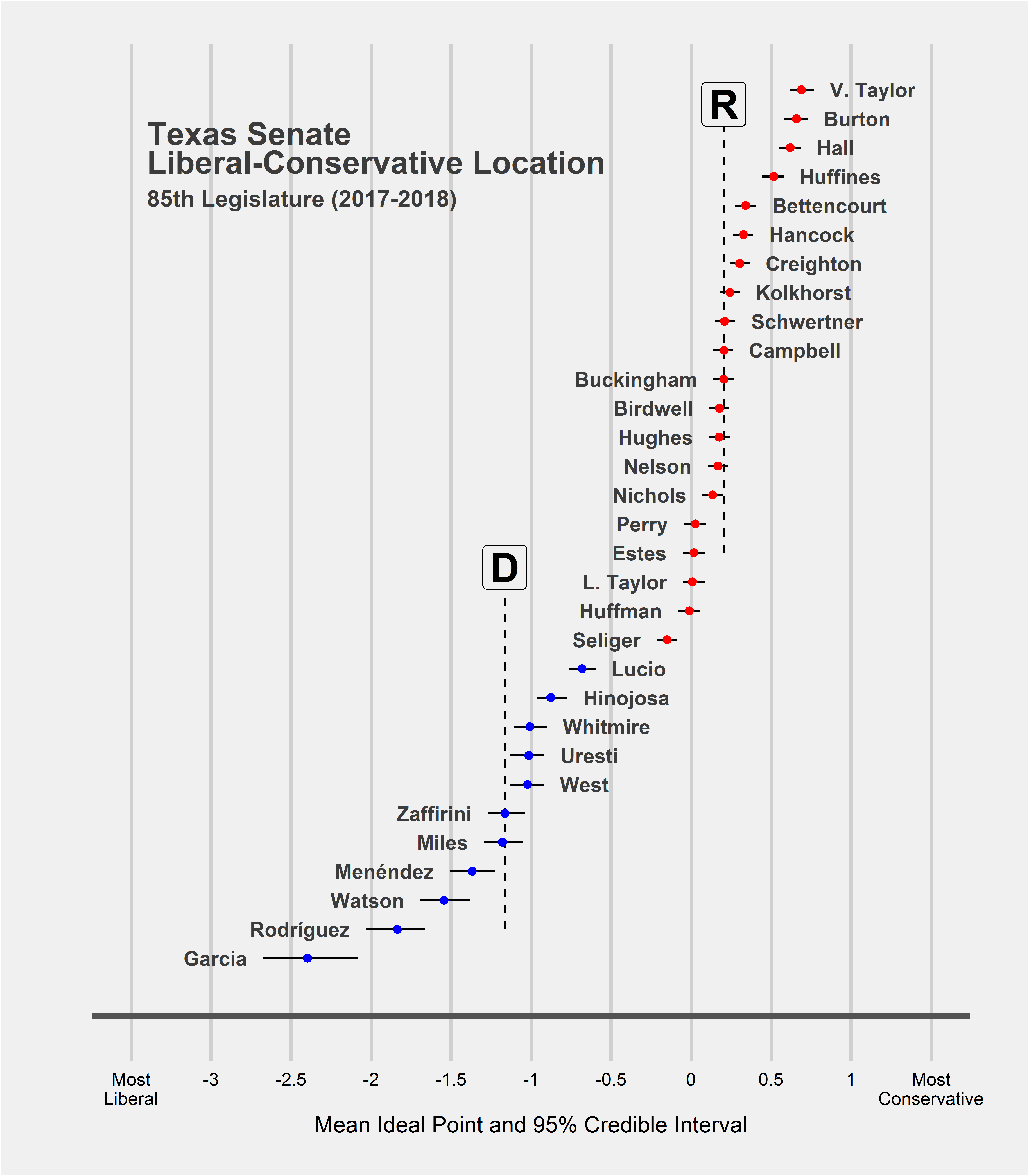
Mark Jones is a political science professor at Rice University.  Every odd numbered year, he produces a non partisan index that ranks the members of the Texas Legislature from left to right.  Jones' index is worth investing some time into because, while the methodology is more complicated than some other groups, it's the most comprehensive analysis of individual members of the Texas Legislature.

Texas House Results:

Note: Click on the image to enlarge.

Texas Senate Results:


In no particular order, some personal observations:
  • Freedom caucus (predictably) solidify their position as the 12 most conservative House members.
  • Kel Seliger is the most liberal Republican in the Texas Senate; over half of the Republican caucus in the House is more liberal than Seliger.
  • In the House, we would give every member from Rodney Anderson up a passing grade on voting record; that's 31 members out of a 95 member Republican caucus.
  • However, even among those 31 members with passing grades on their voting record, there are three (Drew Springer, Dennis Bonnen, and Larry Phillips) who receive automatic F's based on other shady actions; so 28 members out of a 95 member House Republican caucus ultimately receive passing grades.
  • 26 Republican House members have more liberal voting records than Byron Cook; chew on that one for a second.
  • Jason Isaac moves significantly to the right from 2015 to 2017; this is consistent with a number of observations we made during the session.
  • In the other direction, Jodie Laubenberg, James White, Giovanni Capriglione, Tan Parker, and Phil King continued their multi-session leftward drift.
  • Speaking of leftward drift, Dan Flynn is now in the bottom half of House Republicans.
  • Rafael Anchia and Chris Turner both rank significantly to the left of the average Democrat in the House...are they sure those are the two guys they want to make spokespeople for their entire party?!?
  • On the Senate side, all Republicans elected in the past 7 years are significantly to the right of the person they replaced.
    • Update: We suppose that technically Paul Bettencourt is about even with the guy he replaced in SD-7.
  • Charles Perry and Larry Taylor both have voting records to the left of Bob Nichols; while people shouldn't overreact, this is a trend worth monitoring.
  • Joan Huffman as the second most liberal Senate Republican might be flying a little too close to the sun for her own good in her re-elect cycle.
Read the full report (including a detailed discussion of methodology) for the House here and the Senate here.

Tuesday, May 23, 2017

#TXLEGE: City of Austin's session gets a little bit worse!!!


"Talk no more so very proudly;
Let no arrogance come from your mouth,
For the Lord is the God of knowledge;
And by Him actions are weighed.
1 Samuel 2:3

Lost in the end of session shuffle, check out this amendment that Jason Isaac managed to tack onto another bill at the last moment:
Notwithstanding any other law, a municipality to which this chapter applies may not designate a district under this chapter if the municipality has adopted a requirement in any form, including through an ordinance or regulation or as a condition for granting a building permit, that establishes a maximum sales price for a privately produced housing unit or residential building lot. The restriction described by this subsection does not apply to property that is part of an urban land bank program.
Isaac's amendment precludes a price control scheme that is sometimes euphemistically mislabeled as "inclusionary zoning;" the Foundation for Economic Education details this practice:
But the latest trend in socially conscious planning is so-called “inclusionary zoning,” which mandates some portion of new, market-priced housing developments be set aside for low-income persons who will be charged below-market rates.

The idea is to make the rich subsidize housing for the poor. But this acts as a price ceiling on new units that actually discourages rather than encourages new construction.
Currently, Austin does not engage in this practice.  That being said, we've been hearing for months that Council was planning to push "IZ" forward as soon as the lege leaves town.  Fortunately, Isaac's amendment pre-emptively prohibits going down this rabbit hole.

Bottom Line: Nicely done....

Wednesday, May 3, 2017

#TXLEGE: Bonnen hears (at least) 9 more special interest carve out bills (98 for session)....


"Dishonest scales are an abomination to the Lord,
But a just weight is His delight."
Proverbs 11:1

It's that time of week when we check on the latest from Dennis Bonnen and the Texas House Ways and Means committee:
  • HB 660        Villalba | et al.
    Relating to a sales and use tax exemption for Texas state flags.
  • HB 976        Giddings
    Relating to the exemption from the sales tax for certain school art supplies during limited periods.
  • HB 1164       Guillen
    Relating to the application of the sales and use tax to the lease or rental to a caterer of certain tangible personal property.
  • HB 2621       Darby                 
    Relating to state and local tax incentives for certain enhanced oil recovery projects.
  • HB 3138       Gutierrez               
    Relating to the definition of intangible personal property for ad valorem tax purposes.
  • HB 3389       Schofield              
    Relating to fees taxed as costs of suit for certain delinquent tax suits.
  • HB 3709       Sheffield             
    Relating to authorizing a county to impose a tax on the sale of certain solid materials and substances.
  • HB 3975       Ashby                 
    Relating to qualification of land for appraisal for ad valorem tax purposes as timber land.
  • HB 3999       Isaac | et al.        
    Relating to the appraisal for ad valorem tax purposes of certain property used to provide affordable housing.

Monday, April 24, 2017

#TXLEGE: Statewide grassroots leadership invites Warren Buffett to join Free Market auto sales coalition!!!


"Dishonest scales are an abomination to the Lord,
But a just weight is His delight."
Proverbs 11:1

With the Senate risking its credibility over this absurd "Buffet Bill," we were honored to join statewide grassroots leadership in signing this letter:

Bottom Line: One of two things needs to happen.  If this bill can be amended to include direct sales for everyone, that would be fine.  Otherwise, this bill needs to die.

-----

We encourage readers to tweet this letter to Warren Buffett: @WarrenBuffett

Tuesday, April 11, 2017

#TXLEGE: House considers limiting "historical" zoning designations....

Former Austin Historic Landmark Commission member Arif Panj testifies

"Is it not lawful for me to do what I wish with my own things? Or is your eye evil because I am good?"
Matthew 20:15

[Note: HB 3418 is the final bill under consideration here; our testimony can be found at the 2:44:20 mark.]

[Note II: Learn more about the history of this issue in Austin here and here and here.]

This afternoon, the Texas House committee on Urban Affairs heard HB 3418 (Elkins).  Elkins' bill would create objective criteria for "historic" designations and require a 75% super-majority requirement for a city council to zone something historic against the property owners will.  Abuses of historic designations to inhibit housing construction is a problem that has been growing in recent years in Austin that can spread statewide if the legislature doesn't nip it in the bud.

An important note: Rep. Elkins' bill only pertains to historical designations that are done against the property owners will.  This bill has no impact on historic zoning when the property owner is in agreement.  This bill only becomes relevant when a city (usually at the behest of a politically powerful neighborhood association)

One central Austin home-builder testified that the historic designation process delayed a project upon which he was working for nine months and added an additional $300k to the cost.  That translated to an additional $10,000 per house for the final buyer.  How many people will no longer be able to afford the house with the additional $10,000?!?

Former state rep Burt Solomons testified that neighborhood associations try to exhaust property owners by dragging out the time and expense involved in these processes.  Another Austin resident testified that the City refused to allow tearing down a house that had been condemned as uninhabitable because it was zoned historic.  We testified that the abuses are well documented and that the bill eliminates uncertainty (our one regret is that we neglected to mention the threat this poses to other cities if Austin is allowed to get away with it).

The highlight of the afternoon was the testimony of former Austin historic landmark commission member Arif Panju.  Arif testified that in his two years on the historic landmark commission, he only saw "7 or 8" cases come before the commission where the property owner was in agreement with the designation.  Likewise, Arif stated that historical zoning is being used to "keep people out" of neighborhood rather than any legitimate purpose.

As to the opponents: They were primarily bureaucrats from various urban "preservation" offices around the state.  They said about what you would expect them to say about how there's no problem with anything they're doing and that we just don't understand the issue.  Still, a couple remarks do stand out.  One gentleman who used to work with the state preservation board opposed the bill and called for more funding for "training."  Another opponent claimed there are 'trade-offs" involving private property rights when you move into an urban area.

Bottom Line: The bill was left pending, and a substitute is working its way through lege council, but it's a pleasant surprise to see the legislature take up this issue.

-----

Saturday, March 11, 2017

2017 #TXLEGE Tesla Bills look MUCH Stronger!!!


"And no one puts new wine into old wineskins; or else the new wine bursts the wineskins, the wine is spilled, and the wineskins are ruined. But new wine must be put into new wineskins.”
Mark 2:22

Yes, thank you:
Instead of looking to create any kind of carve-out that favors the high-end electric car maker, legislation filed Friday would simply allow any vehicle manufacturer to sell directly to Texans — bypassing the middleman dealers — in Tesla's biggest challenge yet to a longstanding state ban on the practice.

The proposal "will allow manufacturers of vehicles any weight, class, size or shape to sell direct to consumers," said state Rep. Jason Isaac, the Dripping Springs Republican who filed the legislation in the House. "It’s a simple, free-market bill to allow that to happen."

State Sen. Bob Hall, R-Edgewood, is carrying the legislation in the upper chamber. He and Isaac filed their bills, Senate Bill 2093 and House Bill 4236, on Friday with hours to go until the deadline to submit legislation for the biennial session.

....

This time around, Tesla is hopeful the legislation is written in a way that assuages concerns that it is giving preferential treatment to the company.

"There are no carve-outs, incentives, subsidies, breaks or deals for any manufacturers here," tweeted David White, who has previously served as a spokesman for Tesla in Texas. "This is all about the consumer and it’s the direct sales model Texans have been asking for."

....

For Isaac, the issue goes beyond Tesla. He recalled having something of an epiphany after recently touring an Amazon facility in Texas and seeing robots zip around with pallets: What if similar technology could one day be used to haul containers up and down the state's highways?

"I really believe in the next 10 to 20 years we are going to see a complete change in our transportation system," Isaac said, "and the last thing I want is any barrier to that technology being available."
We read the bill here, and we can't find anything to dislike; read the full Trib piece here.

Bottom Line: Sometimes, when you have to wait a session or two you just end up with a stronger final product (Note: Something similar might be in the process over parental educational choice).  It might not be necessary, or right, but it's also reality as long as the roster looks the way it does.  This might be one of those cases.

Tuesday, February 28, 2017

#TXLEGE: House Urban Affairs committee hearing illustrates why housing is an expensive cluster[REDACTED]....


"Now may He who supplies seed to the sower, and bread for food, supply and multiply the seed you have sown and increase the fruits of your righteousness,"
2 Corinthians 9:10

The House Urban Affairs committee heard testimony today on an aspect of a state run (but federally funded) subsidized housing program this afternoon.  To be honest, we found the entire discussion infuriating.  If local governments didn't deliberately use zoning and permitting regulations to make it excessively complicated (ie. expensive) to build, there's wouldn't be a constituency for these types of subsidized housing programs in the first place.

The specific program is one that gives the local state rep a de facto veto over subsidized housing developments within their district.  This actually became a gigantic issue in Austin last year.  But the specific program is a symptom, the fact that local governments make it virtually impossible to build is the disease.

A representative from the Texas Affiliation of Affordable Housing providers called regulations, zoning, and permitting: "a pretty intense process."  In context, he was arguing against engaging the local state rep in the process because they weren't intimately familiar with those things.  But, unintentionally, he made the case for why those processes should be dramatically simplified (if not outright eliminated).

The most infuriating part is that, while subsidized housing will never be sufficient to meaningfully impact affordability for the general population, it drives up housing costs for everyone who doesn't receive a subsidy.  Case in point: the program discussed today had about 2570 recent recipients in Harris County and 213 in Collin...but those are areas that have millions of people in the case of Harris and hundreds of thousands in the case of Collin.  Furthermore, decisions about who receives subsidized housing tends to be based on political connections rather than genuine need.

To his credit, Jason Isaac seemed to understand that these programs can't ever be sufficient but do make things more expensive for the rest of us; we encourage him to trust his instincts.

At this point, quoting Reagan has become a tiresome cliche, but we can think of nowhere where this one is more appropriate: "If it moves, tax it. If it keeps moving, regulate it. And if it stops moving, subsidize it."

Bottom Line: Subsidies can never fix the problems regulation creates.

Monday, July 18, 2016

Jason Isaac talks sense on Marijuana reform


"He has shown you, O man, what is good;
And what does the Lord require of you
But to do justly,
To love mercy,
And to walk humbly with your God?"
Micah 6:8

Good for him:
Texans who are arrested for possessing small amounts of marijuana shouldn’t be locked out of jobs and haunted by minor lapses in judgment for the rest of their lives, business and legislative leaders say.

As acceptance of marijuana — medical and otherwise — grows nationally and in Texas, members of both major political parties in the Legislature have staked out positions supporting the decriminalization of possession of small amounts of marijuana. The proposed change could be beneficial for Texas businesses, proponents have said.

State Rep. Jason Isaac, R-Dripping Springs, told the American-Statesman that too many Texans have missed out on jobs because of criminal records that involve nonviolent drug charges. Isaac said he plans to support decriminalization bills in the upcoming legislative session, which will begin in January, to make sure more Texans can get jobs and not face a lifetime with the stigma of a criminal conviction.
Read the whole thing here.

Monday, July 20, 2015

Meet the Super Liberal Education Bill that Passed Straus' House


"And have no fellowship with the unfruitful works of darkness, but rather expose them."
Ephesians 5:11

"Community schools" are a euphemism for all in one social service centers that cover the cradle component of 'cradle to grave.'  We attended a government school lobby event early in the 84th session where they were discussed extensively.  Our own (Democrat) state rep, Eddie Rodriguez, was carrying the bill.

The idea sounded so far-fetched that, to be honest, we forgot about it.  Earlier today, on a whim, we decided to see which bills Eddie Rodrigez managed to pass.  What we discovered was shocking.

The Texas House, under Joe Straus' leadership, actually passed the community schools bill (HB 1891); making matters worse, Jimmie Don Aycock (Straus handpicked education committee chairman) was a co-author on the bill.

How the vote went down:
HB 1891 ON THIRD READING
(by E. Rodriguez, Farney, S. Turner, VanDeaver, and Aycock)
HB 1891, A bill to be entitled An Act relating to Texas community schools.
HB 1891 was passed by (Record 1151): 69 Yeas, 52 Nays, 3 Present, not voting.

Yeas — Allen; Alonzo; Alvarado; Anderson, C.; Aycock; Bernal; Blanco; Canales; Coleman; Collier; Cyrier; Darby; Davis, S.; Davis, Y.; Deshotel; Dutton; Faircloth; Farias; Farney; Farrar; Frank; Giddings; Gonzales; Gonzalez; Guerra; Guillen; Gutierrez; Harless; Hernandez; Howard; Huberty; Isaac; Israel; Johnson; King, S.; King, T.; Klick; Lozano; Lucio; Martinez; Martinez Fischer; McClendon; Minjarez; Moody; Morrison; Mun˜oz; Naishtat; Neva´rez; Oliveira; Pen˜a; Pickett; Raymond; Rodriguez, E.; Rodriguez, J.; Romero; Rose; Schofield; Sheets; Sheffield; Stephenson; Thompson, S.; Turner, C.; Turner, S.; VanDeaver; Vo; White, J.; Workman; Wu; Zerwas.

Nays — Anderson, R.; Bell; Bohac; Bonnen, D.; Bonnen, G.; Burns; Burrows; Button; Capriglione; Craddick; Dale; Elkins; Fletcher; Flynn; Galindo; Geren; Goldman; Kacal; Keffer; Keough; Koop; Krause; Landgraf; Larson; Leach; Metcalf; Meyer; Miller, D.; Miller, R.; Murphy; Murr; Paul; Phelan; Phillips; Price; Riddle; Rinaldi; Sanford; Schaefer; Shaheen; Simmons; Simpson; Smith; Spitzer; Springer; Stickland; Tinderholt; Turner, E.S.; Villalba; White, M.; Wray; Zedler.

Present, not voting — Mr. Speaker; Clardy; Kuempel(C).

Absent, Excused — Anchia; Cook; Dukes; Fallon; Frullo; Herrero; King, K.; King, P.; Laubenberg; Longoria; Ma´rquez; Miles; Otto; Raney; Reynolds; Smithee; Thompson, E.; Walle.

Absent — Ashby; Burkett; Crownover; Hughes; Hunter; Paddie; Parker;Schubert.

[Author's Note: Emphasis added to highlight how Republican members in close proximity to Travis County voted.]
Even Charlie Geren voted against this flaming bag of junk.

Bottom Line: The Senate rightfully killed this bill, but for a 'community schools' bill to pass the Texas House in the first place tells you everything you need to know about Texas House leadership.

Friday, February 6, 2015

Gio Gets Played


"The wise shall inherit glory,
But shame shall be the legacy of fools."
Proverbs 3:35

On Wednesday, Joe Straus released committee assignments.  While predictably awful, they were also revealing.  For obvious reasons, Gio is a case in point.  According to the legacy GOP narrative, Gio got 'plum' assignments on Appropriations and Local and Consent.  As the concern trolls at Texas Observer so 'helpfully' explain:
But Giovanni Capriglione, a Republican from the Metroplex who bucked his tea party supporters and loudly supported Straus, came out of his ordeal pretty decently. He sits on Appropriations, Local and Consent Calendars, and Investments and Financial Services—the last committee is sought-after for its members ability to raise money from the many well-heeled outsiders who have business before it.
But all is not as it seems.

An individual member makes little difference on any given committee (ESPECIALLY Appropriations).  What matters is the chairmanship and the composition of the committee.  Looking at Gio's committee assignments in context makes it obvious that he will be irrelevant on his 'plum' committees.

Empower Texans and YCT produce the most reliable conservative policy indexes in Texas; their 2013 rankings illustrate Gio's folly:

[Author's note: With a 94.4 from Empower Texans and a 92 from YCT, Gio had the highest score on either index.]

Appropriations:
  • Chairman score: 35.5 ET; 41 YCT.
  • Committee Average (with Gio): 40.5 ET; 40.1 YCT.
  • Committee Average (without Gio): 38.1 ET; 37.8 YCT.
Local and Consent:
  • Chairman score: 22.2 ET; 15 YCT.
  • Committee Average (with Gio): 51.8 ET; 51.7 YCT
  • Committee Average (without Gio): 48.2 ET; 48.4 YCT
  • Committee Average (without Gio, Jason Isaac, or Drew Springer): 39.7 ET; 34.8 YCT. (*)
Bottom Line: Having a "seat at the table" is irrelevant.  Even if you get a "seat," leadership will stack the remaining "seats" at said "table" to make your "seat" meaningless.  Anyone who believes otherwise is a sucker.

Methodology Below:


-----

* -- While we we didn't calculate their respective committee averages, a glance at Jason Isaac's and Drew Springer's assignments reveals a similar phenomenon.

-----

From the great minds think alike department, Tony McDonald likewise observes:
The media were quick to point the finger at those conservatives who had stayed true to their convictions and supported Scott Turner for Speaker. These members were “foolish” and had allegedly been punished with “bad” committee assignments, while members who sold out their principles and constituents were lauded for reaping great “rewards.”

To paraphrase a quote from Ronald Reagan, “It isn’t so much that the liberal media is ignorant. It’s just that they know so many things that aren’t so.”

The reality is that the Speaker and his allies engage in a false barter with members. It reminds us of the trade offered by Bart Simpson to his father, Homer: “I’ll trade you this delicious doorstop for that crummy old Danish,” offered Bart. In much the same way, House leadership, the media, and the lobby are all busy telling members that they will really enjoy a spot on a “powerful” committee if they will just trade in their crummy old ability to vote “no.”

A “coveted” spot on House Appropriations is put up as the sweetest plum of all. Many in the media were quick to latch on to the fact that Rep. Giovanni Capriglione, who infamously turned his back on his former conservative ally Scott Turner at a local Tea Party meeting, was given a spot on the “budget writing” committee.

However, as we have pointed out before, members on the Appropriations Committee don’t actually write the budget. That task is reserved for a small handful of appointees to the Legislative Budget Board (LBB) and the bureaucrats they employ. After the budget is released by the LBB, the Appropriations Committee members meet early and often, but only end up tinkering around the edges of the initial document. Then, after both chambers pass the budget, it is sent to another small hand-selected group on the conference committee who largely rewrite the document as they see fit.
-----

Update: Another funny note is that Gio, Isaac, and Springer were the only low-threshold conservatives to get on any of the important committees; the rest were shut out completely.